New Model Context Protocol Server Aims to Reduce Payment Integration Timelines from Days to Minutes
By Financial Technology Frontiers (FTF) Editorial Team
Executive Summary
As artificial intelligence increasingly transforms software development, a new challenge is emerging: ensuring AI-generated code remains accurate, secure, and aligned with constantly evolving application programming interfaces (APIs). Mesh, the digital payments and crypto infrastructure company, believes it has found a solution.
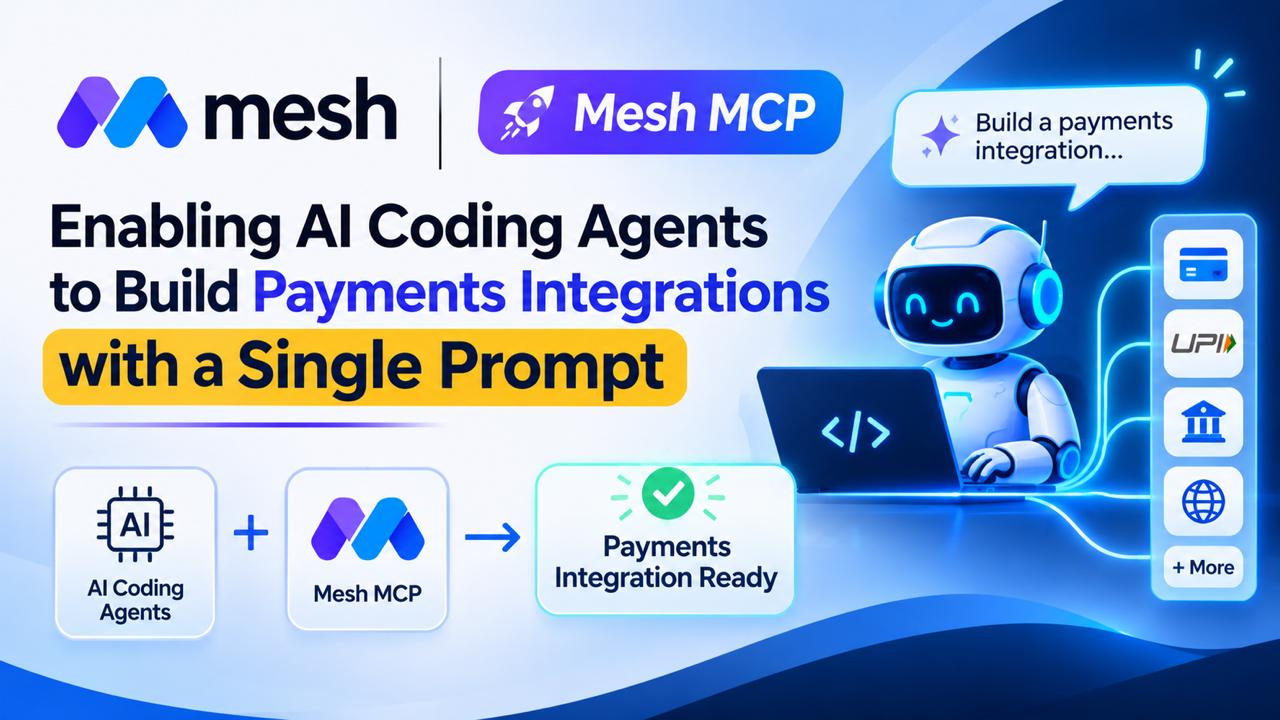
On November 24, 2026, Mesh announced the launch of Mesh MCP, a hosted server built on the Model Context Protocol (MCP) that allows developers to integrate Mesh’s payment capabilities using natural-language prompts through AI coding agents. The company says the technology can reduce integration timelines from several days to as little as three minutes by providing AI agents with direct access to Mesh’s live API documentation and specifications.
The announcement reflects a growing trend across the technology sector: the emergence of AI-native developer tools designed to improve the reliability of AI-generated software while accelerating development workflows.
From Coding Assistant to Integration Engineer
The rise of AI coding tools has fundamentally altered how developers build software. What began as code-completion assistance has rapidly evolved into agentic development environments capable of:
- Writing application code.
- Generating integrations.
- Debugging software.
- Creating documentation.
- Managing development workflows.
According to the announcement, developers using Mesh MCP can simply describe what they want to build using natural language. For example, a user could type:
“Add crypto checkout to my store.”
The AI coding agent would then:
- Identify the relevant Mesh API endpoints.
- Retrieve current schemas directly from Mesh’s documentation.
- Generate integration code.
- Validate requests against the live API specification.
- Build a functioning integration workflow.
Rather than relying on information stored within an AI model’s historical training data, Mesh MCP enables agents to access live and authoritative information directly from the source. According to Mesh, a process that previously required several days of developer effort can now be completed in a matter of minutes.
Addressing a Growing AI Development Challenge
The launch comes as AI coding tools achieve widespread adoption among professional software developers. Mesh cited findings from the JetBrains Developer Ecosystem Survey 2026, which reported that approximately 90% of professional developers now use AI coding agents at least weekly.
Despite this growing adoption, reliability remains a critical concern. Many developers report that AI systems often generate outputs that are nearly correct but not production-ready. While minor inaccuracies may be acceptable in some applications, they can create significant challenges in financial services and payment processing environments where precision is essential.
Potential issues can include:
- Incorrect API fields.
- Missing request parameters.
- Outdated endpoints.
- Improper authentication handling.
- Invalid response structures.
In payment environments, even small implementation errors can result in:
- Failed transactions.
- Customer friction.
- Security concerns.
- Compliance issues.
- Delayed product launches.
Mesh MCP seeks to address these risks by allowing AI agents to retrieve current API specifications directly from Mesh rather than relying on potentially outdated knowledge.
How Mesh MCP Works
According to Mesh, the platform creates a direct connection between AI coding tools and the company’s live API specifications. When a request is initiated, Mesh MCP can provide:
- Current API endpoints.
- Exact request schemas.
- Response validation requirements.
- Documented API behavior.
- Error explanations and troubleshooting guidance.
Because the platform references live documentation, integrations remain aligned with current API versions as the platform evolves. Arjun Mukherjee, Chief Technology Officer at Mesh, described the objective as ensuring AI agents have access to the same information that human developers would use when building production software:
“Developers already build with AI agents daily. The question is whether those agents are working from the most up-to-date information. Mesh MCP gives every coding agent a direct line to our API, so a builder can describe what they want and have a working, validated integration in minutes instead of days.”
For financial infrastructure providers operating in highly regulated and security-sensitive environments, the accuracy of generated code may become just as important as the speed at which it is produced.
Key Capabilities of Mesh MCP
According to Mesh, the platform delivers several capabilities designed specifically for payment and financial-service integrations.
Integration in Minutes
Mesh MCP includes predefined implementation playbooks for common use cases, including:
- Payments.
- Deposits.
- Wallet ownership verification.
This allows AI agents to build complete workflows with minimal user intervention.
Built-In Debugging
The platform assists developers by:
- Explaining error codes.
- Validating responses against API specifications.
- Identifying likely implementation issues.
Secure by Design
Mesh noted that:
- Developers authenticate through their Mesh accounts.
- API credentials do not enter AI tools.
- The MCP server operates in read-only mode.
- The platform does not move funds or execute transactions.
Broad AI Tool Compatibility
Deployment can reportedly be completed using a single setup command. Mesh MCP supports:
- Claude Code.
- Claude.
- Cursor.
- Codex.
- Other development tools supporting the Model Context Protocol.
The Emergence of AI-Native Financial Infrastructure
The launch of Mesh MCP highlights an emerging trend in financial technology: infrastructure providers are beginning to optimize not only for human developers but also for AI development agents.
Historically, APIs were designed around human consumption. Documentation was written for engineers who read technical references, studied integration guides, and wrote application code manually. The emergence of AI-assisted software development is creating demand for a different model—one in which APIs are designed to be both machine-readable and machine-consumable.
Under this model:
- AI agents discover functionality autonomously.
- Documentation becomes dynamically accessible.
- Integrations are generated through natural language.
- Validation occurs automatically against authoritative specifications.
Mesh MCP represents one of the more visible examples of this transition within the payment infrastructure sector.
Building on Earlier AI Initiatives
The MCP launch follows several recent initiatives from Mesh aimed at reducing complexity in digital payments and crypto-enabled transactions:
- Link Chat: Introduced in October 2026, Link Chat enables users to fund accounts, initiate transactions, and manage payment activities through natural-language interactions.
- Visa Partnership: Mesh announced a partnership with Visa designed to allow consumers to spend cryptocurrency and stablecoin balances from existing wallet applications across Visa’s global merchant acceptance network, extending spending capabilities to approximately 175 million merchant locations worldwide.
Together, these initiatives suggest a broader strategy focused on simplifying the interaction between users, developers, and financial infrastructure.
What This Means for Developers and Financial Institutions
For software developers, Mesh MCP offers the potential to:
- Accelerate integration timelines.
- Reduce implementation errors.
- Improve developer productivity.
- Lower onboarding barriers for payment infrastructure.
For financial institutions and fintech providers, the implications may be broader. As software development becomes increasingly AI-driven, organizations may begin evaluating infrastructure providers not only on payment functionality, but also on how effectively their platforms support AI-assisted development environments. This shift could influence:
- API design standards.
- Developer experience strategies.
- Fintech integration models.
- Platform-selection decisions.
Organizations that make their infrastructure more accessible to AI agents may gain a competitive advantage in attracting developers and accelerating product deployment.
FTF Editorial Analysis
Mesh MCP represents more than a new developer tool; it offers a glimpse into what may become the next phase of financial technology infrastructure. For years, fintech providers competed on the breadth of their APIs, the quality of their documentation, and the sophistication of their developer ecosystems. Increasingly, however, a new requirement is emerging: making infrastructure understandable not only to human developers, but also to AI agents.
As AI-assisted software development moves into the mainstream, the challenge is shifting from generating code to ensuring that generated code is accurate, secure, and continuously aligned with changing systems. In highly sensitive environments such as payments and financial services, where even small implementation errors can lead to failed transactions or compliance concerns, access to live and validated information becomes critically important.
Mesh’s adoption of the Model Context Protocol reflects a broader industry recognition that future developer experiences may begin with a natural-language prompt rather than a technical manual. If that transition accelerates, the financial institutions and infrastructure providers that successfully adapt their platforms for AI-native development could become the preferred building blocks for the next generation of financial applications.
Source: Mesh Pay Press Release