As AI becomes more capable and increasingly autonomous, it also becomes a new attack surface. What happens when an AI System / Solution is manipulated, impersonated, poisoned, stolen, compromised or simply goes wrong?
Financial Technology Frontiers (FTF)’s 10-part AI Security Risks Series examines the ten key AI Security Risks highlighted by the Canadian Centre for Cyber Security (CCCS), and goes beyond technology to explore the What, How, Impact and Control of each Risk. This series is designed to give Business Leaders and Technology, Cybersecurity, Risk and Compliance Professionals a practical framework for understanding and managing the many faces of AI Risk.
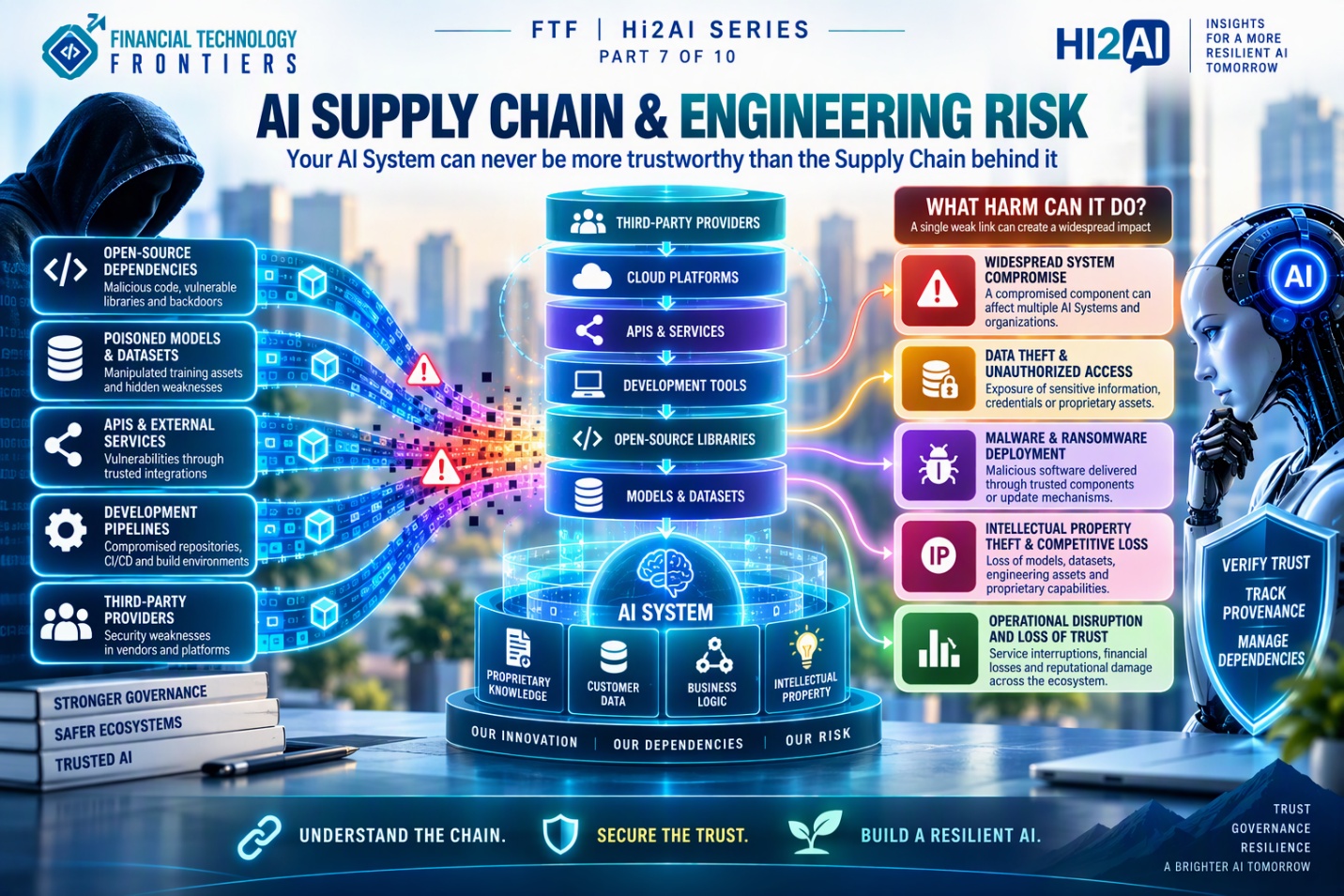
Organizations rarely build modern AI Systems entirely themselves. Today’s AI capabilities are typically assembled from a complex Ecosystem of Models, Datasets, APIs, Open-Source Libraries, Development Tools, Cloud Platforms and Third-Party Providers. This interconnected approach accelerates innovation and reduces development costs, but it also introduces dependencies that may exist beyond an Organization’s direct control.
Every dependency represents an element of trust. When that trust is misplaced, a weakness originating anywhere within the AI Supply Chain can ultimately become a weakness within the AI System itself.
As AI adoption accelerates, Organizations must recognize that securing the AI System alone is no longer sufficient. They must also understand, govern and protect the Ecosystem upon which that AI System depends.
What Is It All About?
AI Supply Chain & Engineering Risk arises when a compromised Component, Dataset, Software Dependency, API, Development Tool, Repository or Third-Party Provider introduces Security weaknesses into an AI System.
Rather than attacking an Organization directly, attackers may target the Technologies, Services and Components used to build, deploy or operate AI Systems. Because these components are often trusted by default, a compromise can propagate through the Supply Chain and affect multiple downstream Organizations simultaneously.
As AI Ecosystems continue to expand, Organizations increasingly need visibility not only into their AI Systems, but also into the technologies, providers and dependencies that support them.
Security agencies and leading standards bodies (see References) increasingly recommend Controls such as AI Bills of Materials (AI-BOMs), Software Bills of Materials (SBOMs), Cryptographic signing of AI Systems and Artifacts, dependency scanning, Provenance tracking, Change Control and Secure Development Practices to strengthen AI Supply Chain Resilience.
How Does This Threat Attack?
Attackers often find it easier to compromise trusted upstream dependencies than to directly attack a well-protected Organization. Potential attack techniques include:
- ■Compromising Open-Source Components and Software DependenciesMany AI Systems rely upon Open-Source Libraries, Frameworks, Python Packages and Model Components. Attackers may introduce malicious code, Vulnerabilities or backdoors into these dependencies, allowing compromise to spread downstream when Organizations install or update trusted Packages. Because such dependencies are often reused across multiple environments, a single compromise can have widespread consequences.
- ■Poisoning AI Models, Datasets and Training AssetsAttackers may compromise Models, Datasets, Embeddings or Training Artifacts before they reach the Organization. Once incorporated into Development Pipelines, these Assets may influence AI Behaviour, introduce Vulnerabilities or create hidden weaknesses that persist throughout the AI Lifecycle.
- ■Exploiting APIs, Plugins and External ServicesModern AI Systems frequently rely on APIs, Plugins and Cloud-Based Services to provide capabilities and access to external resources. A compromised Integration can introduce Vulnerabilities directly into an AI Environment, potentially affecting Confidentiality, Integrity and Availability while remaining outside the Organization’s direct control.
- ■Compromising Development Pipelines and Engineering EnvironmentsAttackers may target Source Code Repositories, CI / CD Pipelines, Model Registries, Development Tools and Build Environments used to create AI Systems. Manipulation at this stage can allow malicious Code, unauthorized Model changes or compromised Components to enter production environments before detection.
- ■Exploiting Third-Party AI Providers and Supply Chain RelationshipsOrganizations increasingly depend on AI Vendors, Cloud Providers and Managed AI Platforms. Weak Security practices, compromised Infrastructure or inadequate Governance anywhere within the extended Supply Chain can introduce risks that the Organization neither created nor directly Controls.
The challenge is that many of these components are trusted because they originate from familiar, reputable or routinely used sources. Once a compromised dependency enters the Supply Chain, the resulting weakness may be inherited by every Organization that relies upon it.
What Harm Can This Risk Do?
The consequences of AI Supply Chain compromise can extend well beyond a single AI System. Potential impacts include, but are not limited to:
- ■Widespread System CompromiseA compromised Dependency, Model, Library or Development Tool may provide attackers with a pathway into multiple AI Systems simultaneously. Because AI Supply Chains often support numerous Organizations, a single compromise can create cascading systemic impacts across multiple environments.
- ■Data Theft and Unauthorized AccessCompromised Components may enable attackers to access Sensitive Information, Credentials, Intellectual Property, Customer Data or Proprietary AI Assets. In some cases, the compromise may remain undetected for extended periods while Data is quietly collected or exfiltrated.
- ■Malware and Ransomware DeploymentSupply Chain attacks can be used to distribute malicious Software through trusted update mechanisms, Development Tools or Vendor Platforms. Organizations may unknowingly deploy compromised Components that later facilitate Malware execution, Ransomware events or other forms of Cyberattack.
- ■Intellectual Property Theft and Competitive LossAI Models, Datasets, Engineering Assets, Business Logic and proprietary capabilities may be exposed or stolen through Supply Chain weaknesses. This can undermine years of investment, reduce competitive differentiation and provide adversaries with valuable organizational knowledge.
- ■Operational Disruption and Loss of TrustCompromised AI Components can result in outages, degraded performance, service interruptions and business disruption. Beyond operational impacts, Organizations may suffer reputational damage if Customers, Partners or Regulators lose confidence in their ability to securely manage AI technologies.
One of the most significant challenges is that Organizations often inherit these risks unknowingly. By the time a Supply Chain weakness is identified, the Vulnerable component may already have been incorporated into production environments across multiple systems and business functions.
What Can Organizations Do To Control This Risk?
Organizations cannot manage AI Supply Chain & Engineering Risk simply by securing their own environment. Modern AI Systems are assembled from Models, Datasets, APIs, Open-Source Libraries, Development Tools, Cloud Services and Third-Party Platforms, each introducing its own Security assumptions and Trust dependencies. AI Security therefore depends not only on protecting the actual AI System being used, but also on understanding, governing and continuously monitoring the broader Ecosystem that contributes to it. Organizations should consider undertaking the following:
- ■Establish Comprehensive AI Asset Visibility and ProvenanceOrganizations should maintain an AI Bill of Materials (AI-BOM) and AI-specific Software Bill of Materials (SBOM) identifying Models, Datasets, Libraries, APIs, Development Tools and Third-Party Components used throughout the AI Lifecycle. Data Provenance, Component Traceability and Dependency Mapping help establish trust, support investigations and accelerate remediation when Vulnerabilities are discovered.
- ■Verify the Integrity of Models, Datasets and ArtifactsOrganizations should verify the Authenticity and Integrity of AI Assets before deployment and after significant updates. Cryptographic Signing, Hash Verification, Artifact Validation and Trusted Distribution Mechanisms help ensure that Models, Datasets and Components have not been manipulated, replaced or tampered with within the Supply Chain.
- ■Continuously Monitor and Scan DependenciesDependencies should be continuously assessed for Vulnerabilities, malicious modifications and emerging Threats. Dependency Scanning, Vulnerability Management, Continuous Monitoring and Threat Intelligence help identify compromised Components before they affect production environments.
- ■Implement Secure AI Engineering and Change ControlsSecure Development Lifecycle practices should extend to AI Systems and associated Components. Organizations should apply Code Reviews, Model Validation, Change Management Procedures, Configuration Controls, Testing Requirements and Controlled Release Processes throughout Development and Deployment Pipelines.
- ■Govern Third-Party Providers and Supply Chain RiskVendor Due Diligence should extend beyond the immediate AI Provider to include the critical dependencies that support the service. Organizations should evaluate Security Practices, Engineering Controls, Dependency Management Processes, Incident Reporting Requirements, Transparency Obligations and Vendor Risk Management capabilities across the broader AI Ecosystem.
Unlike traditional Software Supply Chains, AI Supply Chains include Models, Training Assets, Embeddings, Vector Stores, Knowledge Bases and AI-Specific Components. As a result, Supply Chain Assurance should become an ongoing Governance activity rather than a one-time procurement exercise.
FTF Analysis
AI Supply Chain & Engineering Risk may become one of the most significant yet least visible risks facing enterprise AI. Organizations often focus heavily on evaluating the AI Provider delivering a capability while overlooking the broader Ecosystem of Models, Dependencies, Datasets, APIs, Toolchains and Cloud Services that support that capability. This creates an important Governance challenge.
It is common to find Organizations frequently asking, “Can we trust this AI Vendor?” But a more appropriate question worth asking would be:
“Can we trust what the AI Vendor relies upon?”
Every Model, Dataset, Open-Source Library, API, Development Tool and Cloud Service introduces an additional trust relationship and an additional attack surface. Many of these dependencies remain largely invisible to the Organizations consuming AI capabilities. As AI Systems become increasingly interconnected, risks introduced into a single upstream Component may be inherited by several downstream Organizations. What begins as a Vulnerability in one dependency can rapidly become an Enterprise-wide or Industry-wide issue.
FTF believes AI Supply Chain Security should increasingly be treated as a core AI Governance function rather than solely an Engineering or Cybersecurity activity. Visibility, Provenance, Traceability and Trust should become foundational requirements for AI Assurance. Organizations that are most likely to succeed will not necessarily be those that deploy AI the fastest. Instead, they will be those that can confidently answer a more fundamental question: “Do we understand the chain of trust behind the AI System(s) we are relying upon?”
Because ultimately, an AI System can never be more trustworthy than the Supply Chain that supports it.
About This Article
This Article examines AI Supply Chain & Engineering Risk as an emerging AI Security challenge affecting Organizations that increasingly rely on external Models, Datasets, Development Tools, APIs, Open-Source Components and Third-Party Providers. It explores how Vulnerabilities introduced anywhere within the AI Ecosystem may propagate into downstream environments. It examines the Governance, Engineering, Security and Supply Chain Controls Organizations should establish to strengthen trust, Resilience and Assurance throughout the AI Lifecycle.
This Article is authored by Narasimham Nittala who leads the Strategy and Research vertical of Financial Technology Frontiers (FTF). This Article is published as part of FTF’s Hi2AI Series. Like our previously published Articles, this Article is written in an accessible, practitioner-focused format and it aims to raise awareness about responsible AI adoption across various Institutions.
FTF believes that service providers, Fintech entities, consulting firms and technology companies can all benefit from reflecting on the perspectives shared here and consider how their own approaches to AI Risk Management can evolve. Practitioners in various industries are equally encouraged to adapt these insights to their unique contexts.
About Hi2AI
Hi2AI is FTF’s AI Ecosystem for Financial Services. Hi2AI is a trusted community shaping the future of Artificial Intelligence in Financial Services by driving responsible innovation, influencing policy with regulators, and crafting future standards that ensure growth, Resilience, and trust across the global financial Ecosystem. Hi2AI exists to accelerate the responsible adoption of AI across the global financial Ecosystem through:
- AI-Driven Industry Collaboration.
- Ecosystem Connection & Innovation.
About Financial Technology Frontiers
Financial Technology Frontiers (FTF) is a global media-led fintech platform dedicated to building and nurturing innovation Ecosystems. We bring together thought leaders, financial institutions, fintech disruptors, and technology pioneers to drive meaningful change in the financial services industry.