SINGAPORE, 20 November 2026
Artificial intelligence dominated both FinTech competitions whose winners the Monetary Authority of Singapore (MAS) and the Singapore FinTech Association (SFA) announced on 19 November at the Singapore FinTech Festival (SFF) 2026. Every problem statement in the Global FinTech Hackcelerator was an AI challenge, and the thematic category in this year’s SFF FinTech Excellence Awards was dedicated to an AI champion.
- 195 applications from 52 jurisdictions; 16 finalists pitched at Demo Day on 18 November
- GXS Bank challenge: FinBox (India)
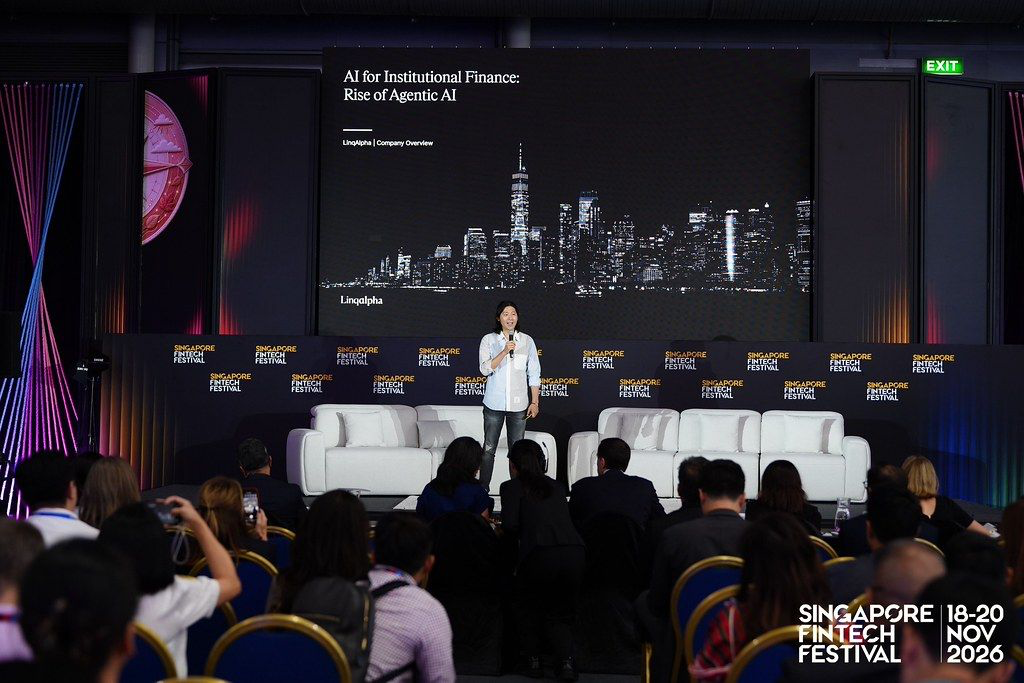
- Julius Baer challenge: LinqAlpha (Singapore)
- Zurich Insurance challenge: PROSPERO (Indonesia)
- Each winner receives S$80,000 in prize money
Global FinTech Hackcelerator: three AI challenges, three winners
The Hackcelerator, organised by MAS in partnership with the Global Finance & Technology Network (GFTN), drew 195 applications from 52 jurisdictions. Sixteen finalists pitched at a Demo Day on 18 November, and three winners, one for each problem statement set by corporate champions GXS Bank, Julius Baer and Zurich Insurance, will each receive S$80,000 in prize money.
For GXS Bank’s challenge on unifying credit and fraud risk modelling in digital banking, the winner was FinBox of India, with DeviceConnect and Sentinel AI. According to the MAS announcement, the solution captures consented behavioural signals, combines them with bureau data and scores them as a single learning system; the organisers describe every decision as explainable, with policy changes simulated on historical data before deployment.
For Julius Baer’s challenge on wealth management for digitally native clients, the winner was LinqAlpha of Singapore. MAS describes its AI advisory agent as working inside the client’s existing email inbox and a web application, answering plain-language questions with portfolio-specific responses, and drafting anything that touches on advice for a relationship manager’s approval before it is sent.
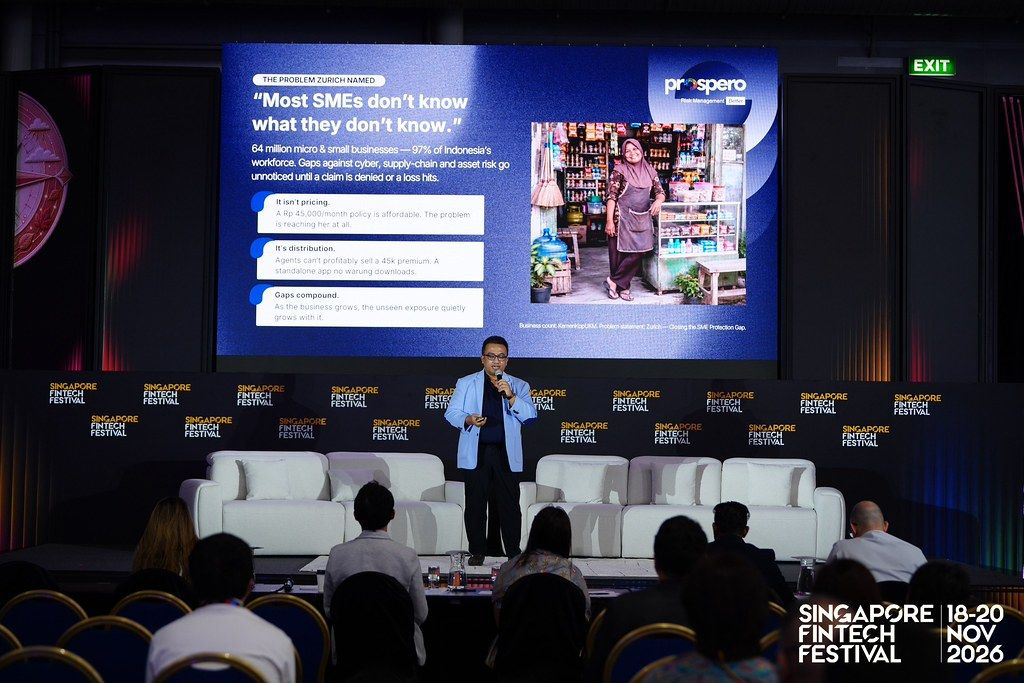
For Zurich Insurance’s challenge on SME risk, the winner was PROSPERO of Indonesia, with SME RiskLens. According to the announcement, the solution sits on the company’s risk engine, turns a small business’s data into a plain-language risk profile and flags insurance coverage gaps, using Indonesia’s 83,000-cooperative programme to give insurers a structured pre-underwriting signal.
SFF FinTech Excellence Awards: eight winners from 131 submissions
In the SFF FinTech Excellence Awards, organised by MAS and SFA with support from PwC Singapore, eight winners were chosen from 131 submissions across six categories.
ContexQ (Singapore) won the Emerging FinTech Award for SarasW, which the company describes as a decision-intelligence platform that resolves fragmented records into connected views of people, companies and relationships. Payoneer Singapore Private Limited won the Financial Inclusivity Award for its Global Financial Platform. FinregE (United Kingdom) won the Regulatory Leader Award for its Regulatory Operating System. ESGSAT (United States) won the Sustainable Innovator Award for ESGSAT Orbit. bolttech (Singapore) won the Thematic AI Champion Award for its AI-enabled insurance distribution platform.
The FinTech Individual Mentor Award went to Carney Mak, Partner at FXHB Asset Management; Naveed Weldon, CEO of FlexM; and Ragunandhan Senthil Kumar, CTO of Bank-Genie.
What the organisers said
“Many of them integrate AI with strong governance and human oversight, which is exactly what the industry needs as adoption deepens.”
Kenneth Gay, Chief FinTech Officer, MAS, in his congratulatory remarks
SFA President Holly Fang framed the results against the association’s tenth anniversary:
“From first-time founders to established leaders, this is an ecosystem that has seen tremendous growth, and we look forward to seeing how these innovators continue to raise the bar for FinTech in Singapore and globally.”
Holly Fang, President, Singapore FinTech Association
Financial Technology Frontiers Analysis
Our view after reading the announcement and its annexes: the most telling detail is not who won, but what the organisers chose to reward. The published criterion for the AI Champion category is “the most meaningful real-world deployment, clear business impact and responsible use at scale”, and the three Hackcelerator champions each asked for AI applied to a defined operational problem rather than an open-ended showcase. Read alongside the safeguards described in each winning entry, from explainable scoring to manager approval, the 2026 awards sketch a picture of what one of Asia’s leading financial regulators and its industry association want AI adoption to look like. That is an interpretation of the published selections and criteria, not a statement of the judges’ motives.
The corporate-champion format deserves attention from North American banks and insurers. Instead of sponsoring a generic pitch competition, GXS Bank, Julius Baer and Zurich Insurance each wrote a specific business problem and let a global field compete to solve it. Whether that model shortens the path from pilot to deployment is an open question the announcements do not answer, but it is a format worth testing for institutions still running broad, theme-less innovation challenges.
Finally, the map matters. The winners span India, Singapore, Indonesia, the United Kingdom and the United States, with an American company, ESGSAT, taking the sustainability category. For North American readers, these awards function less as a ranking and more as an early read on which capabilities Asian financial centres are spotlighting, and this year that spotlight sits squarely on AI with visible controls.