The United States and Canada are the first markets for the new capability, which lets merchants share richer transaction data with card issuers before authorization decisions are made.
Global Payments announced on November 9, 2026 that it is expanding its Adaptive Authentication platform with the addition of the Visa Intelligent Data Exchange (IDX) API, a capability the company says will help its clients in the United States and Canada improve authorization rates, reduce unnecessary customer challenges and optimize payment performance (Global Payments press release, November 9, 2026).
The enhancement allows Global Payments clients to share richer transaction data with issuers, supporting more informed authorization decisions. According to the company, that data sharing is intended to reduce false declines and to lift conversion without adding checkout friction. Adaptive Authentication is available to clients globally; the Visa IDX API addition is initially available for eligible domestic US and Canadian transactions.
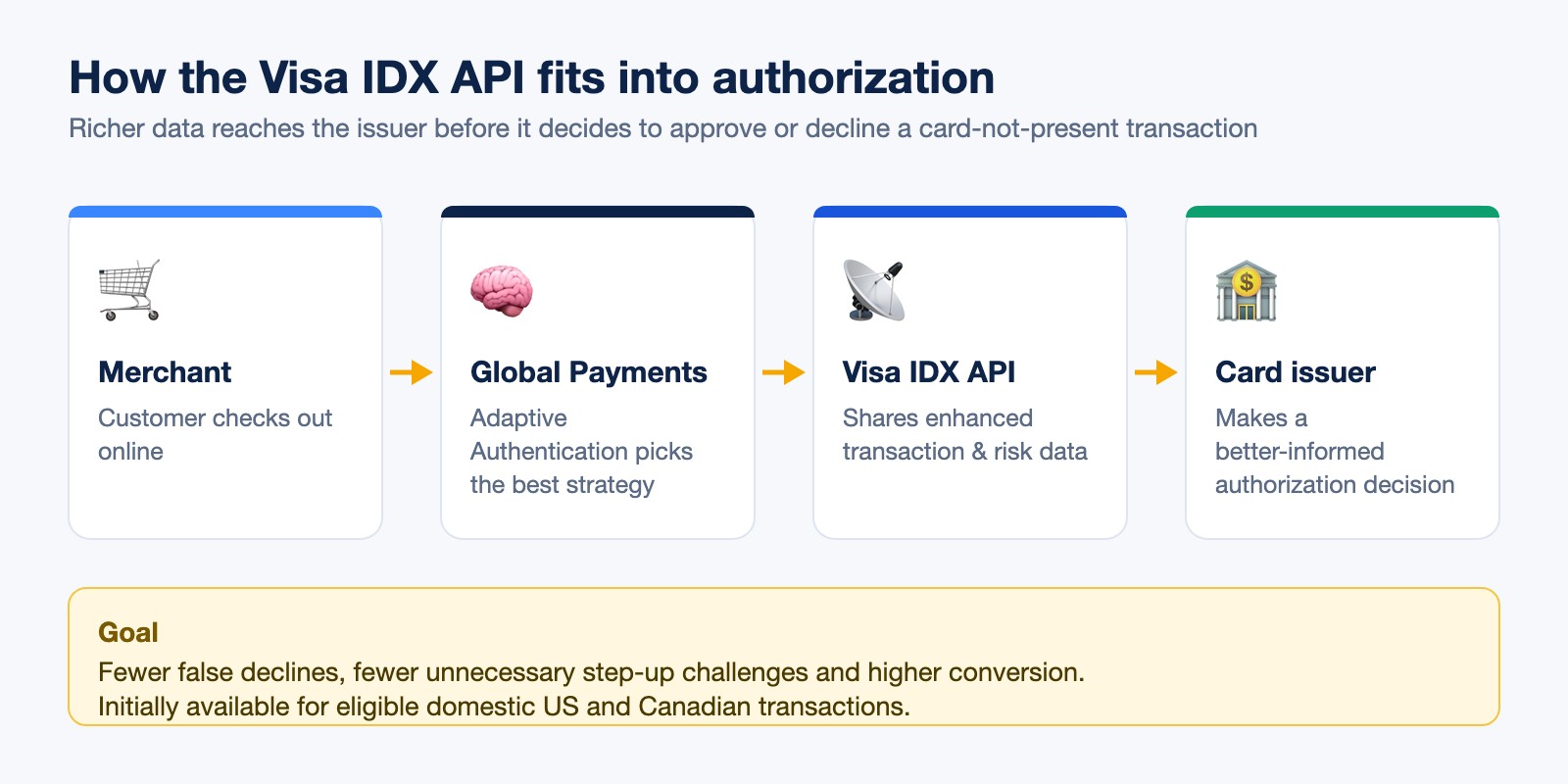
Adaptive Authentication, which Global Payments describes as AI-powered, dynamically selects what the company considers the most effective authentication strategy for each transaction. Its toolkit includes 3D Secure, Data Only authentication, SCA exemptions and now the Visa IDX API. Visa’s product terms for the API, dated April 21, 2025, describe the Visa IDX API as “designed for the purpose of sharing enhanced data including transaction data and transaction risk assessment, with Issuers to help improve Card Not Present (CNP) transaction performance,” and state that the terms apply in Canada and the United States (Visa Intelligent Data Exchange API Product Terms).
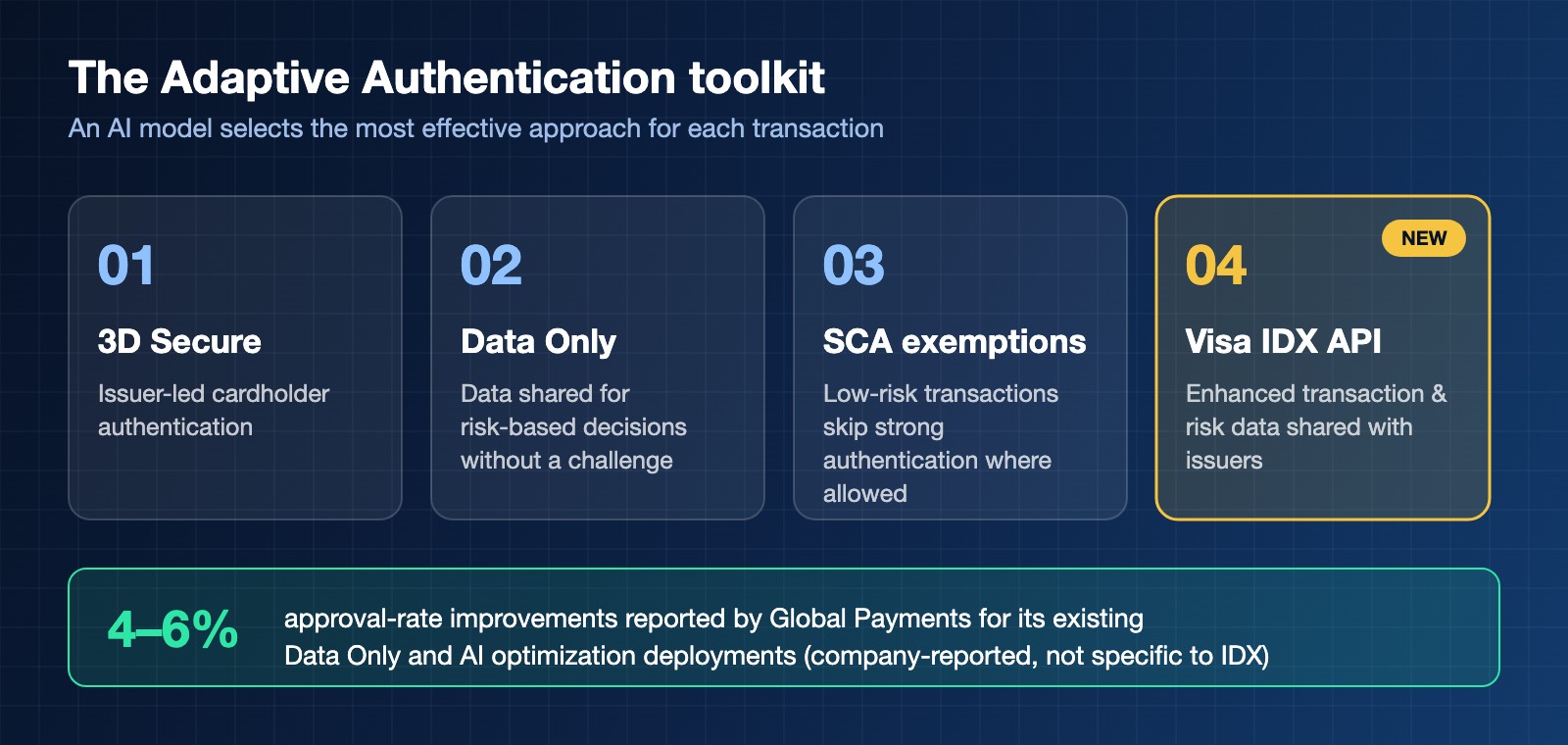
Global Payments reports that deployments of Data Only authentication and the platform’s AI-powered optimization model have helped merchants achieve approval-rate improvements typically ranging from four to six percent. That figure is company-reported and relates to existing capabilities; the release does not state a measured approval lift attributable to the IDX addition itself.
“Every time a legitimate customer has their transaction declined, it is a lost revenue opportunity.”
— John Winstel, Senior Vice President, Value Added Services, Global Payments
“Visa Intelligent Data Exchange API is designed to provide issuers with richer transaction insights as part of the authorization process, helping merchants improve approval rates and reduce false declines.”
— Cietan Kitney, Head of Product, North America, Visa
The company positions the expanded platform alongside the fraud and risk capabilities provided by Ravelin and its global scale: the company states it manages trillions of dollars in payments volume and billions of transactions across more than 175 countries.
A history of collaboration
The two companies have worked together before, in different parts of the payments stack. In October 2021, Visa said it was working with Cybersource, FIS, Global Payments and TSYS, a Global Payments company, “in several markets across the globe to enable the Visa Installments Solution” (Visa press release, October 27, 2021). In July 2017, Global Payments partnered with CaixaBank, Samsung, Visa and Arval to establish a payment innovation hub in Barcelona (Global Payments press release, July 13, 2017). Visa also lists Global Payments in its partner directory. Those earlier collaborations concerned installment payments and innovation programs respectively, not authentication data exchange.
Financial Technology Frontiers Analysis
Analysis, distinct from the reported facts above.
What this could mean for customers
If the mechanism works as described: merchants send richer transaction data through the Visa IDX API, and issuers can then make authorization decisions with more context. If issuers use that data as intended, the plausible effects for merchants are fewer legitimate transactions declined, fewer step-up challenges presented to genuine customers at checkout, and less manual recovery work for support teams. None of these outcomes is established by the announcement itself; each depends on issuer participation and on performance that Global Payments has not yet published for the IDX addition specifically.
What this could mean for the wider ecosystem
An open question raised by this launch is whether structured data exchange between the acceptance and issuing sides of card-not-present payments becomes a standard layer alongside fraud screening. If it does, the center of gravity in authentication shifts from standalone tools toward orchestration: selecting, transaction by transaction, among 3D Secure, Data Only authentication, SCA exemptions and issuer data exchange. Whether that orchestration layer remains bundled inside large processors’ platforms or becomes accessible to smaller payment providers is an unresolved competitive question.
Open questions
This announcement is a processor-side bet that authentication strategy, not just acceptance, is where merchants will pay for value-added services. Several open questions follow.
- Measurement: the four-to-six percent improvement Global Payments cites belongs to its existing Data Only and optimization deployments, so the incremental effect of richer data exchange with issuers remains unproven in public.
- Participation: data sharing only improves authorization decisions if issuers consume and act on the data, and the release does not say how many issuers are equipped to do so.
- Sequencing: Global Payments chose the US and Canada as the first markets for the IDX addition while keeping the wider platform global. An open question for go-to-market watchers is whether two-market first launches of this kind become the default pattern for issuer-dependent features.
What this single announcement cannot establish is merchant uptake, pricing, or how quickly eligibility extends beyond domestic US and Canadian transactions.
Sources
- Global Payments Inc., “Global Payments Expands Adaptive Authentication Platform,” November 9, 2026: investors.globalpayments.com (source version: businesswire.com)
- Visa, “Visa Intelligent Data Exchange API Product Terms,” dated April 21, 2025: developer.visa.com
- Visa, “Visa Helping Fuel ‘Buy Now, Pay Later’ Growth Around the World,” October 27, 2021: usa.visa.com
- Global Payments Inc., Barcelona payment innovation hub release (with CaixaBank, Samsung, Visa and Arval), July 13, 2017: investors.globalpayments.com
- Visa partner directory, Global Payments listing: partner.visa.com