
TD Restricts Third–Party AI Agents From Client Banking Access
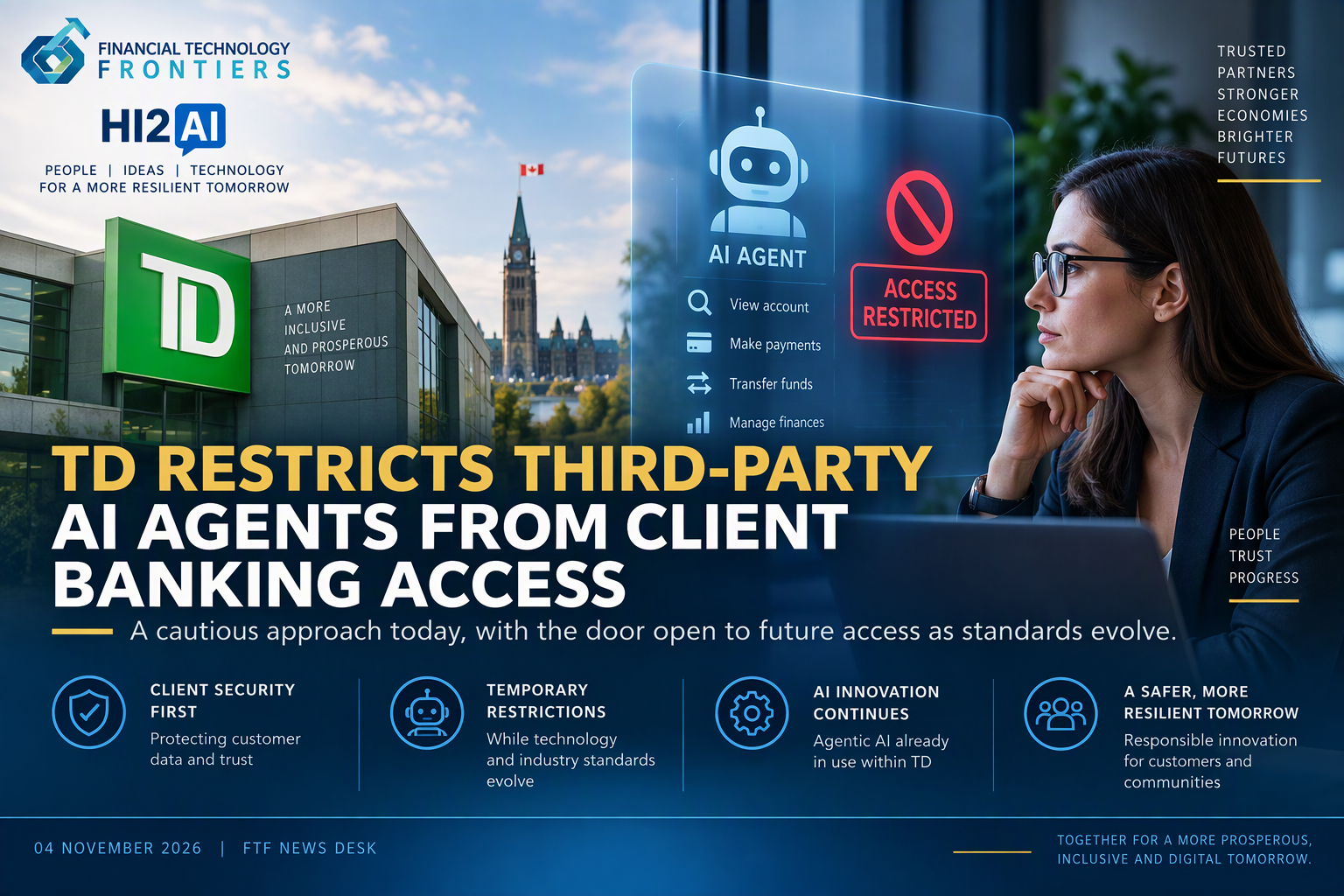
TD Bank is temporarily restricting third-party personal AI agents from directly accessing customer banking information that requires authentication, describing the move as a safeguard while it evaluates the technology and its associated risks.
As the debate over AI agents and Financial Services continues to intensify, TD Bank has publicly clarified its position. In an article published on 04 November 2026, through its own TD Stories platform, TD confirmed that it is temporarily restricting third–party personal AI agents from directly accessing customer banking information requiring authentication while the Institution evaluates the technology and its associated risks.
The announcement is significant because it provides the first direct explanation from a major Canadian bank regarding the increasingly discussed issue of AI–agent access to Financial accounts. While earlier reporting highlighted actions being taken by Canadian Financial Institutions, TD’s publication places the bank’s rationale firmly on the public record and offers insight into how one of Canada’s largest Financial Institutions is approaching the intersection of AI innovation, customer convenience, security, and trust.
TD has told clients it is introducing measures across its systems to temporarily restrict third–party personal AI agents – apps that can act on a user’s behalf – from directly accessing banking information where client authentication is required. The bank set out its position in an explainer published on TD Stories on November 04, 2026. According to TD’s publication, the restriction is not intended as a permanent prohibition on AI–agent access. Instead, the bank describes the measures as a temporary safeguard while it continues assessing the implications of an evolving technology landscape.
TD is not the only Canadian bank to act. BMO, CIBC and RBC have also moved to block personal AI agents from their systems, citing safety and security, per reports from CBC News on 29 October 2026.
Why AI Agent Access Raises New Questions
AI agents represent the next evolution of artificial intelligence. Beyond answering questions or providing recommendations, these systems can execute actions on behalf of users, such as making payments, initiating transfers, managing budgets, or interacting with Financial platforms. While the potential benefits are substantial, technology introduces complex questions regarding authentication, authorization, accountability, privacy, cybersecurity, and fraud prevention.
TD believes these concerns warrant a measured approach. As Vlad Shpilsky, Group Head, Global Technology & Solutions at TD, stated:
“AI agents have enormous potential to make managing money simpler and more intuitive. But when this technology is acting on a client’s behalf, their privacy, security and control come first.”
FTF Analysis
Over the past several weeks, much of the discussion around AI agents in Financial Services has focused on what Canadian banks are preventing. TD’s publication adds a critical layer to that conversation by explaining why. The most important takeaway is not that TD is restricting third–party AI agents. It is that the restriction is being framed as temporary, risk–assessment–driven, and subject to future review. The bank has not closed the door to AI agents; it is waiting for stronger guardrails to emerge.
In many respects, TD’s position may represent the emerging compromise model for the industry. Banks are accelerating their use of agentic AI within their own environments, where governance, monitoring, accountability, and security controls already exist. Third–party AI agents, however, remain outside that trust boundary until common standards for authentication, authorization, liability, and oversight are established.
This creates a two–track future for AI in Financial Services: rapid growth of internally governed AI capabilities alongside a more cautious path for external AI agents seeking direct access to customer accounts.
What remains unresolved is who will define the rules for trusted agent access. Will the industry converge around common standards, accreditation models, and trust frameworks, or will each Institution establish its own requirements? And as Canada’s Consumer–Driven Banking framework evolves, will future accreditation regimes extend beyond data–sharing participants to include AI agents acting on behalf of consumers?
Viewed alongside the Bank of Canada’s recent consultation on Consumer–Driven Banking, the contours of that future are beginning to emerge. The central question is no longer whether AI agents will become part of Financial Services. The question is under what conditions Financial Institutions, Regulators, and consumers will trust them to act on their behalf.
About Financial Technology Frontiers (FTF)
Financial Technology Frontiers covers developments shaping banking, financial services, fintech, payments, insurance and emerging financial technologies, offering industry perspectives and analysis for the financial services ecosystem.