FTF News Desk
Financial Technology Frontiers · 05 November 2026
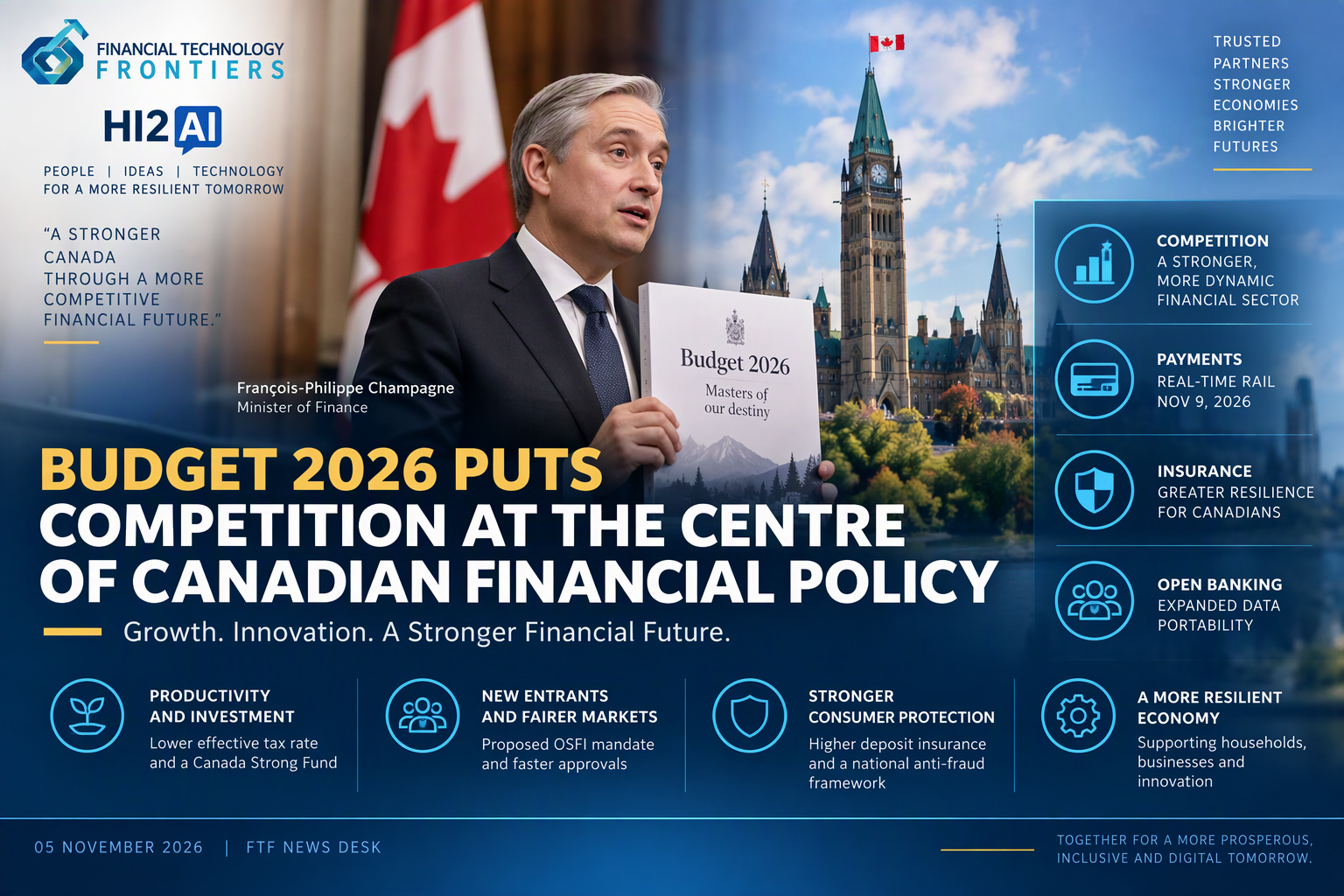
Finance Minister Francois-Philippe Champagne tabled Budget 2026 in the House of Commons on November 05, 2026, according to the Department of Finance news release. The Budget’s headline pitch is a Productivity Mega Deduction that lowers the marginal effective Tax Rate on new business investment from 13% to 6.4%, and a Canada Strong Fund, described by the Government as Canada’s first Sovereign Wealth Fund, to be seeded with $25 Billion over three years, with a principal-protected retail product, Canada Strong Notes, intended for 2027 (Budget 2026 Key Measures).
For Financial Services, the Budget’s recurring theme is competition.
A New Job for the Referee
The Budget proposes to amend the OSFI Act to give the Prudential Regulator a new secondary competition objective, supported by statutory interpretive principles. Prospective entrants to the Federal Financial Institutions Framework would get a maximum statutory one-year decision timeline, and new entrants would be exempt from self-dealing rules while awaiting approval.
The equity threshold at which a Bank is deemed large and must become widely held would rise from $12 Billion to $25 Billion, and Federal Credit Unions would gain more flexibility on shareholder participation and control, subject to ministerial approval.
Deposit Insurance would rise to $250,000, with temporary high-balance coverage for certain life events such as selling a home and no limit for eligible deposits in registered and Tax-free accounts. Supervisory responsibilities would also change: anti-money-laundering oversight of Federally regulated Financial Institutions would move from FINTRAC to OSFI, and a Multi-Sector Anti-Fraud Framework would cap consumer liability for any form of unauthorized transaction across all account types, absent gross negligence by the consumer. All are legislative proposals set out in Annex 3 of the Budget.
Insurance: Investment Rules and Underwriting Support
The Insurance Companies Act would be amended to facilitate additional infrastructure investment by life insurers. On the underwriting side, legislation would establish a Canadian Earthquake Insurance Facility, a cost-sharing arrangement intended to promote stability in the property and casualty industry after an extreme earthquake.
The home price limit for optional mortgage Insurance would rise from $1 million to $1.5 million, with 30-year amortizations where at least one borrower is a first-time buyer or the home is newly built; the Budget gives no start date for the Insurance change. The CRA would receive $13 million over three years, starting in 2027-28, to offer an income verification service to mortgage lenders and insurers (Budget document, pp. 207-208).
Separately announced “missing middle” mortgage Insurance changes take effect February 01, 2027, under a Finance backgrounder.
Payments and Open Banking
On payments, the Budget document names a date for the Real-Time Rail, the instant-payment system built by Payments Canada: it describes the Government as supporting the system’s launch on November 9, 2026, enabling individuals and businesses to send and receive data-rich payments instantly, with immediate access to funds (Budget document, p. 149).
Payments Canada’s own status page says only that the system is launching “in the coming weeks”. The Budget would also amend the Retail Payment Activities Act to strengthen the Bank of Canada’s supervision of payment service providers, promises a public consultation on the next phase of payments modernization in early 2027, and funds a pilot on voluntary digital credentials in Financial Services.
On open Banking, the Budget announces no new launch date for the consumer-driven Banking Framework, though it plans to expand data-portability rights to other sectors, including telecommunications and air transportation. On stablecoins, Federally regulated Financial Institutions would be prohibited from issuing them directly, and the Stablecoin Act would be extended to certain foreign Institutions not subject to prudential regulation (Annex 3).
Status
Everything above is a proposal, not law: the Financial-sector measures require legislation or regulation before they take effect. The November 9 Real-Time Rail date appears in the Budget document; Payments Canada’s own page does not give that date, saying only that the system is launching “in the coming weeks”.
Financial Technology Frontiers (FTF) Analysis
What follows is FTF’s judgment, not established fact.
If enacted, the package would change the conditions of entry rather than any incumbent’s position directly. A statutory one-year decision timeline would cap how long approval can take; a higher deposit-Insurance limit could let smaller Institutions offer insured coverage on larger balances, which could ease deposit gathering; and a competition objective at OSFI would give prospective entrants a formal consideration to cite, though its practical weight would depend on how OSFI applies it.
Whether challengers enter or scale would still turn on applications, capital and execution, none of which a Budget can supply. On payments, the Budget pairs a dated rail launch with no new open Banking date; what that combination means for new entrants cannot be settled from the Budget text, and the operator’s own page does not repeat the November 9 date.
For insurers, the earthquake facility’s effect would depend on design details not yet published. What remains unknown: whether the implementing legislation passes and in what form, when final consumer-driven Banking regulations arrive, and which Institutions take part in the Real-Time Rail at launch.
Budget 2026 sets out a broad proposed reset of the competitive environment for Canada’s financial-services sector. Its impact will depend on the legislation, regulatory detail and market participation that follow.
About Financial Technology Frontiers
Financial Technology Frontiers (FTF) is a global media-led fintech platform dedicated to building and nurturing innovation ecosystems. We bring together thought leaders, financial institutions, fintech disruptors, and technology pioneers to drive meaningful change in the financial services industry.
Source