
An AI budget tells directors what a company plans to spend. It does not tell them what a successful customer interaction costs, whether an automated workflow earns its keep, or who is accountable when it fails. Those are board questions, not merely technology questions.
The economics are no longer hypothetical. When Klarna reported in February 2024 that its AI assistant had handled 2.3 million customer service conversations in its first month, two-thirds of its service chats, it put a figure on what boards are being asked to govern: the company said the system was doing the equivalent work of 700 full-time agents. Those are the company’s own 2024 figures, a snapshot rather than a current measure, and they say nothing by themselves about the full costs or returns of the system. Closing that gap is precisely the board’s job. Not “what are we doing with AI?” but “what does intelligence cost per outcome, and who is watching the return?”
Competence before technology
The central challenge is not to turn every director into an AI technologist. It is whether the board collectively has enough competence to challenge management: what AI can and cannot reliably do; where the organisation depends on models, data, compute and third parties; how AI creates economic value; the major safety, cyber, regulatory and ethical exposures; and where autonomous systems may act and where human accountability must remain. AI literacy belongs in the board skills matrix, director development and board-effectiveness assessment, not delegated to the one director who “does technology.”
AI strategy is also now capital-allocation strategy. Proprietary versus external models, build versus buy, data, talent, cloud and compute concentration: these are choices about the future economics of the industry, not about IT. Boards should ask which capabilities the company must own, where it should partner, and what it should never delegate to a model.
The full cost of intelligence
Generative and agentic AI change the cost structure itself. A single task can involve multiple agents and repeated model calls, multiplying token use, while retrieval and tool integrations can add further costs depending on the design. Aggregate technology budgets hide this. Boards need unit economics: cost per inference, per customer interaction, per autonomous workflow, per successful business outcome, and the margin or revenue each workload generates. The critical question is not whether AI improves productivity but whether it earns sustainable returns after the full cost of intelligence is counted. That argues for governing an AI investment portfolio, not a collection of disconnected pilots.
Who answers when the machine is wrong
Accountability is the harder test. When a customer of Air Canada was misled by the airline’s chatbot about bereavement fares, the airline argued it could not be held liable for what the chatbot said. In a 2024 decision, a Canadian tribunal rejected that argument: the chatbot “is still just a part of Air Canada’s website,” it ruled, and the company “is responsible for all the information on its website.” One tribunal ruling is not a universal legal rule, and obligations will vary by jurisdiction. But the practical lesson for boards travels: delegating a decision to AI cannot mean delegating accountability to AI. Boards should define what can be automated, what requires human review, and what must remain explicitly reserved for human decision-makers.
“Delegating a decision to AI cannot mean delegating accountability to AI.”
The surrounding risk surface is broad: hallucination, bias, model drift, privacy, copyright, data leakage, adversarial attack, third-party concentration and unintended agent behaviour. Boards can draw on the OECD AI Principles, NIST’s voluntary AI Risk Management Framework and the ISO/IEC 42001 management-system standard, while checking applicable law, including the EU AI Act where relevant. Compliance alone, however, is not governance.
India’s financial regulators have been moving in the same direction. SEBI moved beyond consultation in February 2025: its amended Intermediaries Regulations assign responsibility to covered regulated persons for specified data protections, the AI outputs they rely on or deal with, and compliance with applicable law. A separate consultation on responsible AI/ML use followed in June 2025. In August 2025, an RBI committee published its FREE-AI report, recommending a framework for responsible and ethical AI in financial services. For this paper’s argument, the direction is the same as in the global frameworks: the questions it puts to boards, on competence, economic discipline, risk control and accountability, apply in India as much as anywhere.
An operating system for board AI governance
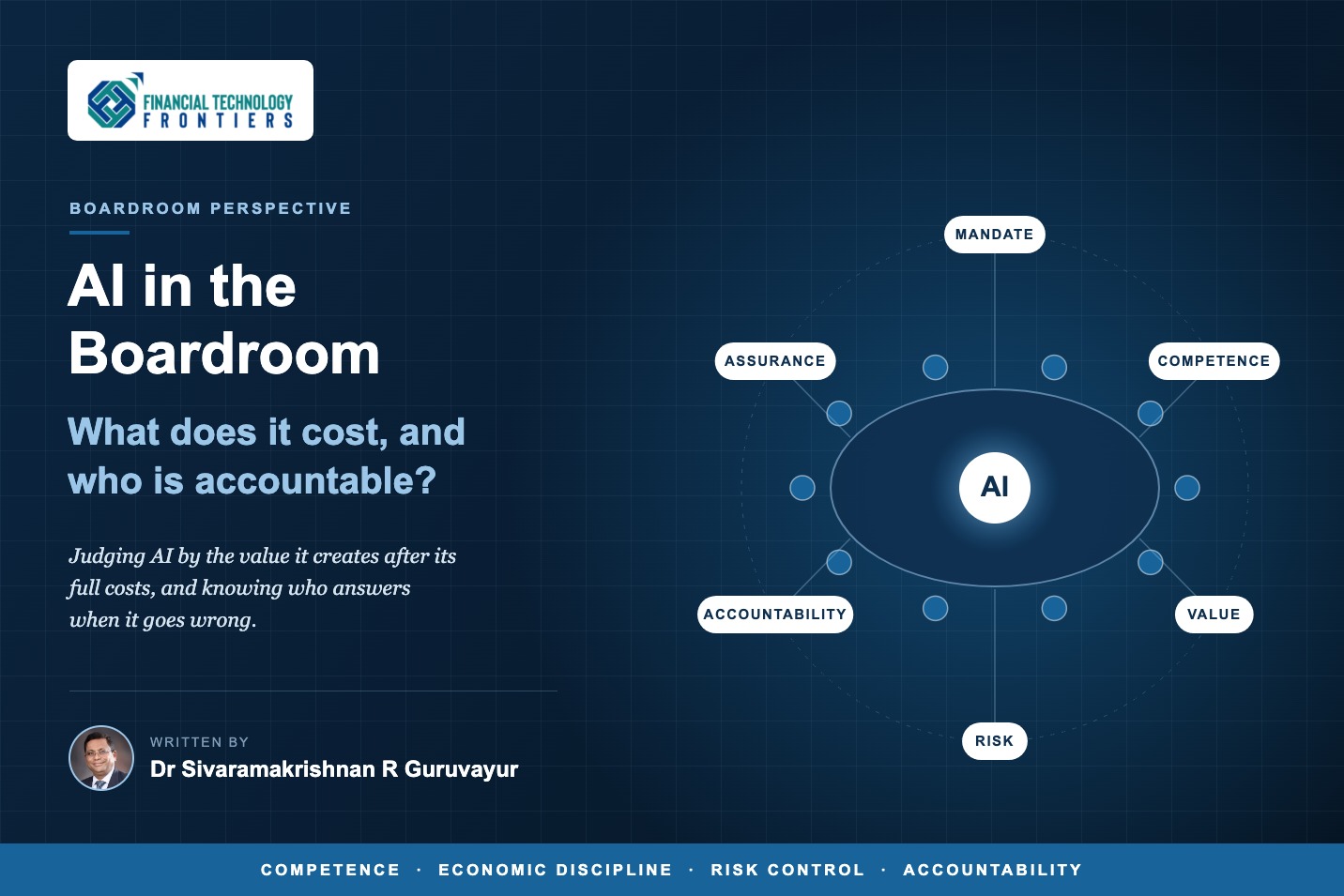
This paper proposes a single operating model to connect those strands to fiduciary responsibility and economics: the Board AI Governance Operating System (B-AIGOS), the author’s proposed overlay on existing governance structures, not a parallel bureaucracy. It spans six domains:
- ■MandateWhich AI decisions belong to the board, committees and management.
- ■CompetenceWhether the board can challenge AI strategy and risk.
- ■ValueHow AI contributes to ROI and enterprise value.
- ■RiskWhich exposures sit within risk appetite.
- ■AccountabilityWho remains answerable for AI-enabled decisions.
- ■AssuranceWhat independent evidence confirms that systems and controls operate as intended.
Decision rights then follow materiality against risk. This mapping is illustrative, subject to each organisation’s own governance and reserved matters:
| Enterprise Materiality | AI Risk | Governance Level | Typical Decision |
|---|---|---|---|
| Low | Low | Management | Internal productivity tools, low-risk copilots |
| High | Low | Executive / Board Committee | Material AI investments with limited risk |
| Low | High | Risk / Technology / Audit Committee | Sensitive AI affecting privacy, compliance or customers |
| High | High | Full Board | Autonomous systems, major AI platforms, critical model dependencies |
A board AI dashboard should track outcomes rather than activity: AI-derived revenue, realised ROI, cost per business outcome, token and inference trends, model reliability, significant incidents, human overrides and third-party concentration. A maturity model running from Reactive to Adaptive lets boards assess each domain separately. Technological maturity should never be confused with governance maturity.
The first year is a proposed improvement plan, not permission to defer the basics: accountability, escalation routes, risk checks and proportionate assurance belong before deployment, not in a later quarter. With that baseline in place, establish the AI inventory, board competency baseline and AI risk appetite in the first quarter. Clarify decision rights, committee ownership and AI ROI and FinOps metrics (FinOps is the discipline of managing cloud and AI unit costs) in the second. Introduce dashboards, scenario exercises and incident-escalation drills in the third. Establish independent assurance and conduct a formal maturity review in the fourth.
Five questions for every chair
- 01Where is AI creating enterprise value?
- 02What is its true economic cost?
- 03What could materially go wrong?
- 04Who is accountable?
- 05How do we independently know that management’s claims are correct?
The defining boardroom challenge of the AI era is not whether companies adopt AI, but whether boards govern it. At the next board meeting, ask management to show the cost, outcome and accountable owner for one material AI use case.
About Financial Technology Frontiers
Financial Technology Frontiers (FTF) is a global media-led fintech platform dedicated to building and nurturing innovation ecosystems. We bring together thought leaders, financial institutions, fintech disruptors, and technology pioneers to drive meaningful change in the financial services industry.
References
- Klarna – AI assistant handles two-thirds of customer service chats in its first month
- Anthropic – Building effective agents
- Civil Resolution Tribunal (BC) – Moffatt v. Air Canada, 2024 BCCRT 149
- OECD – AI Principles
- NIST – AI Risk Management Framework
- ISO/IEC 42001 – AI management systems
- European Commission – EU AI Act regulatory framework
- SEBI – Intermediaries (Amendment) Regulations, February 2025
- SEBI – Consultation paper on responsible usage of AI/ML in Indian securities markets
- RBI – FREE-AI Committee Report