
Part – 9 of 10 | AI Security Risks Series
By Narasimham Nittala
Artificial Intelligence (AI) is becoming embedded in the way Organizations operate, make decisions, and serve customers. The fundamental question today is no longer “Can we use AI?” It is: “Can we use AI responsibly, securely, and resiliently at scale?”
As AI becomes more capable and increasingly autonomous, it also becomes a new attack surface. What happens when an AI System or Solution is manipulated, impersonated, poisoned, stolen, compromised, or simply goes wrong?
Financial Technology Frontiers (FTF)’s 10–part AI Security Risks Series examines the ten key AI Security Risks highlighted by the Canadian Centre for Cyber Security (CCCS), going beyond technology to explore the What, How, Impact, and Control of each Risk. This series is designed to give Business Leaders and Technology, Cybersecurity, Risk, and Compliance Professionals a practical framework for understanding and managing the many faces of AI Risk.
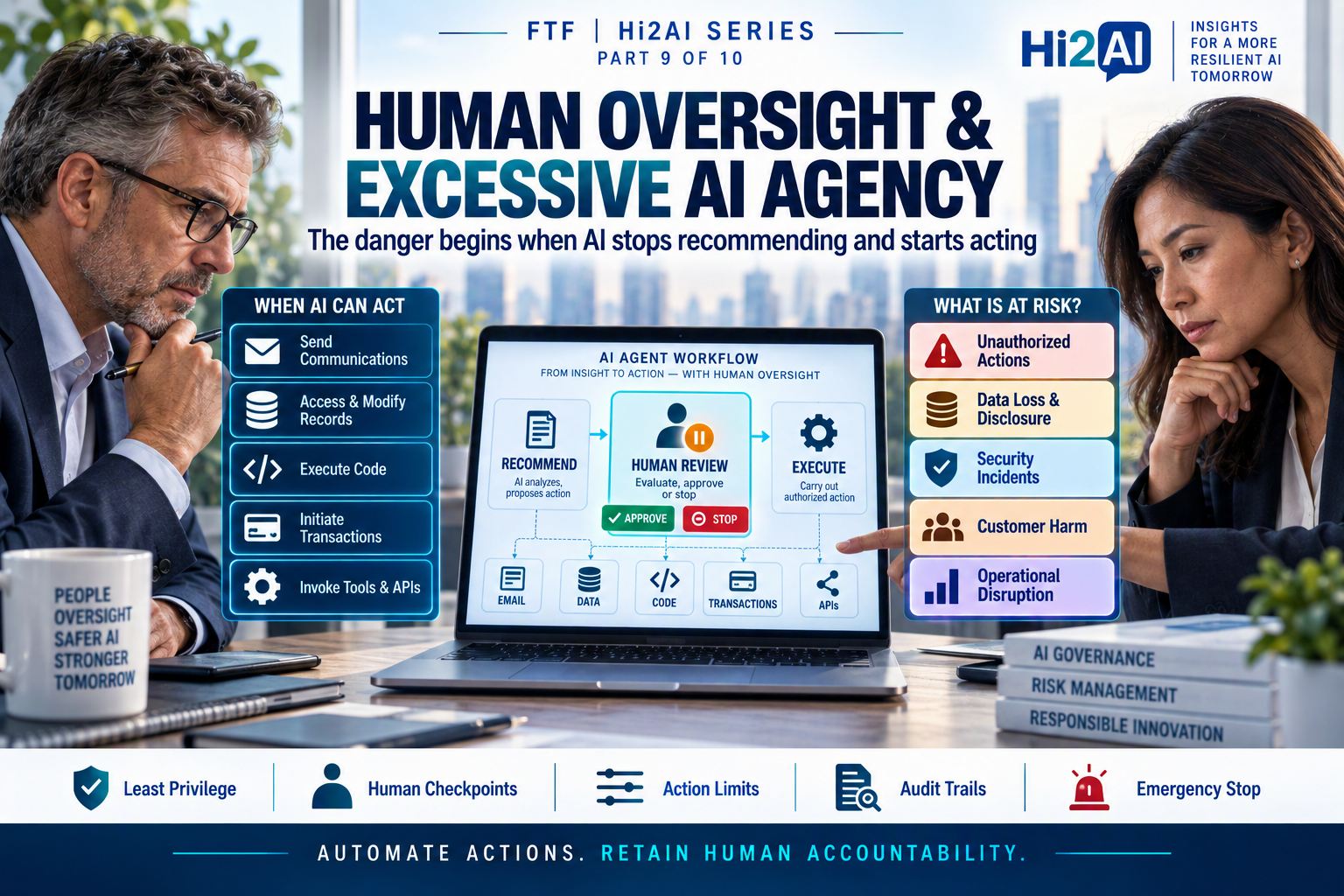
AI Systems are rapidly evolving from Assistants that generate insights, recommendations, and content into AI Agents capable of taking actions on behalf of users. Increasingly, AI Systems can access Applications, invoke Tools, execute Workflows, interact with Databases, and perform tasks that were once reserved exclusively for humans.
This shift introduces significant new opportunities for productivity, efficiency, and automation. However, it also fundamentally changes the Risk equation.
When AI Systems are limited to making recommendations, humans typically remain responsible for reviewing information and deciding what action to take. Once AI Systems are granted the ability to act autonomously, errors, manipulation, or unexpected behaviour may immediately translate into real–world consequences.
“How much authority should an AI System be allowed to exercise without meaningful human oversight?”
What Is It All About?
Human Oversight & Excessive AI Agency refers to the risks that arise when AI Systems are granted excessive functionality, permissions, autonomy, or decision–making authority without appropriate controls, accountability mechanisms, or human supervision. The issue does not necessarily mean that an AI System is malicious. The risk emerges when an AI System is given the ability to perform actions that can affect systems, data, transactions, or business processes without sufficient safeguards.
According to OWASP, Excessive Agency is a vulnerability in which AI Systems are granted excessive permissions or operational authority, allowing unexpected, manipulated, or incorrect AI outputs to trigger actions with potentially harmful consequences. Leading Security and Governance frameworks increasingly recommend the implementation of Human Checkpoints, Explainability Mechanisms, Audit Trails, Escalation Procedures, Action Limits, and Emergency Shutdown Capabilities for high–impact AI activities.
As AI Systems become increasingly integrated into business workflows, Organizations must ensure that autonomy does not outpace accountability.
How Does This Threat Attack?
Unlike traditional Cybersecurity threats, Excessive AI Agency often emerges from the interaction between AI decision–making and real–world permissions. An AI System may be operating exactly as designed. However, if the AI produces an incorrect, manipulated, or unexpected output—and possesses sufficient authority to act upon that output—significant consequences may result. Potential risks from such actions include:
- AI Agents Sending Communications and Taking External Actions: AI Agents may be authorized to send Emails, Messages, Notifications, or Customer Communications without direct human review. A manipulated prompt, incorrect recommendation, or hallucinated response may trigger inappropriate communications, misinformation, or unintended commitments on behalf of the Organization.
- Access to Enterprise Systems, Databases, and Records: Many AI Agents are connected to Databases, CRM Platforms, ERP Systems, and Business Applications. If an AI System misinterprets information, responds to malicious inputs, or accesses incorrect records, it may retrieve, modify, or expose data that should not have been touched.
- Executing Code, Workflows, and Automated Processes: Organizations increasingly use AI Systems to assist with Software Development, Workflow Automation, and Operational Processes. If granted excessive permissions, an AI Agent may execute code, trigger workflows, or initiate processes that create service disruptions, introduce vulnerabilities, or affect production environments.
- Initiating Transactions and Business Operations: AI Agents may be used to support procurement, financial operations, customer interactions, or approval processes. If the underlying decision is incorrect or manipulated, unauthorized transactions, approvals, or operational actions may occur before human review takes place.
- Compromised Inputs, Tools, and Connected Dependencies: The AI Agent itself may not be the original point of failure. Prompt Injection, Malicious Data, Hallucinations, Compromised APIs, or Manipulated Third–Party Systems can all influence the AI’s decisions. If the AI possesses authority to act, these upstream failures can quickly translate into downstream business impact.
The challenge is that AI Agents often inherit the permissions, access rights, and authorities granted to them by humans. When an AI System possesses the ability to act, the resulting consequences can materialize at machine speed and may affect multiple systems, processes, and stakeholders simultaneously. Excessive AI Agency therefore becomes as much a Governance and Risk Management issue as it is a Security issue, requiring Organizations to establish clear boundaries around AI autonomy, decision–making authority, and human accountability.
What Harm Can This Risk Do?
As AI Systems evolve from providing recommendations to taking actions, the consequences of their decisions become increasingly tangible. A flawed recommendation may be reviewed, challenged, or ignored by a human. An autonomous action, however, may be executed immediately across multiple systems, processes, and business functions. As Organizations grant greater authority to AI Agents, they must also recognize that the potential impact of mistakes, manipulation, or unintended behaviour grows proportionately. Potential impacts include, but are not limited to:
- Unauthorized Transactions and Business Actions: An AI Agent may approve purchases, execute transactions, modify workflows, or trigger business processes that were never intended or authorized. Once actions occur, reversal may be difficult, costly, or operationally disruptive.
- Data Destruction, Modification, or Corruption: AI Systems with write–access to Databases, Applications, or Records may accidentally alter, delete, or overwrite information. Even non–malicious errors can significantly affect business operations if safeguards are inadequate.
- Privilege Escalation and Expanded Attack Surface: AI Agents frequently interact with multiple systems and services. Excessive permissions may inadvertently create pathways for attackers to access privileges or capabilities beyond those originally intended.
- Disclosure of Confidential or Sensitive Information: AI Systems with broad access to organizational knowledge may unintentionally expose confidential information, customer data, intellectual property, or regulated content through their actions, responses, or integrations.
- Malicious Code Execution and Security Incidents: AI Agents involved in software development, automation, or infrastructure management may execute scripts, deploy configurations, or interact with production systems. Incorrect actions can create vulnerabilities, outages, or broader security incidents.
- Customer Harm and Operational Disruption: Incorrect AI–driven actions can directly affect customers, employees, and business operations. Errors may result in service interruptions, incorrect account actions, customer complaints, or broader reputational damage.
One of the most significant challenges is that AI actions often occur at machine speed. Problems that once required multiple human approvals may now be executed automatically, reducing the window available for detection and intervention.
What Can Organizations Do To Control This Risk?
The objective should not be to eliminate AI autonomy entirely. Autonomous capabilities in an AI System can deliver significant business value when implemented appropriately. However, Organizations must ensure that authority granted to AI Systems remains proportionate to the risks associated with their actions. The goal is not merely Human–In–The–Loop oversight—the goal is meaningful Human Accountability. Organizations should consider undertaking the following:
- Apply Least–Privilege Principles to AI Agents: AI Systems should receive only the minimum permissions necessary to perform their intended functions. Access to Applications, Databases, APIs, and Processes should be carefully restricted to reduce the impact of incorrect decisions or malicious manipulation.
- Separate Recommendations from Execution: Where practical, AI Systems should recommend actions rather than execute them automatically. High–risk activities such as financial approvals, data modifications, privileged access changes, and customer–impacting decisions should remain subject to human review.
- Require Human Approval for High–Impact Actions: Organizations should establish clear thresholds requiring human intervention before significant transactions, sensitive changes, or material business decisions are executed. Oversight should be risk–based and proportionate to potential consequences.
- Monitor, Log, and Continuously Review AI Agent Activity: Comprehensive Audit Logging, Behaviour Monitoring, and Explainability Controls should be implemented to support accountability and incident response. Organizations should periodically review Agent Permissions, Activity Logs, and Operational Outcomes to identify emerging risks.
- Implement Operational Safeguards and Emergency Controls: AI Systems should operate within clearly defined limits. Rate Limiting, Transaction Caps, Escalation Procedures, Kill Switches, and Emergency Shutdown Capabilities can help prevent isolated failures from escalating into significant incidents.
An Organization’s objective is not simply to oversee AI activity. It is to ensure that responsibility for important decisions never becomes disconnected from accountability. As AI Agents become more capable, connected, and autonomous, Organizations must carefully define the boundaries of AI authority and the decisions that require meaningful human judgment. Human oversight is not measured by the presence of a person somewhere in the process, but by the existence of clear accountability for the outcome. The question is therefore not whether AI can make decisions on our behalf—the question is whether we remain accountable for the decisions it makes.
FTF Analysis
The discussion around AI Governance often focuses on the concept of “Human in the Loop”. While this principle remains important, it may not be sufficient. A human who merely clicks “Approve” hundreds or thousands of times per day without understanding the decision being made is not providing meaningful oversight. In such situations, accountability may appear to exist, but effective governance may not.
This creates a fundamental challenge as AI Agents become more capable and autonomous. Organizations frequently ask: “How can AI help us automate more decisions?” A more important question may be:
“Which decisions should never be automated?”
The distinction between recommendation and execution is particularly important. AI Systems may assist with analysis, prioritization, and decision support. However, decisions involving significant financial impact, customer outcomes, regulatory obligations, legal exposure, or strategic consequences may require meaningful human accountability regardless of how capable the AI becomes.
FTF believes that Organizations should shift the discussion from Human Approval to Human Accountability. The objective should not simply be ensuring that a human is present somewhere in the process. The objective should be ensuring that a clearly accountable individual understands, oversees, and remains responsible for decisions that materially affect the Organization.
Because the danger begins when AI stops recommending and starts acting.
About This Article
This Article examines Human Oversight & Excessive AI Agency as an emerging AI Governance, Security, and Operational Risk. It explores how increasingly autonomous AI Systems, Agents, and AI–enabled workflows may create new forms of exposure when granted excessive permissions, authority, or decision–making capabilities. The Article also examines the Governance, Accountability, Security, and Operational Controls Organizations should establish to ensure that AI autonomy remains aligned with human oversight, risk tolerance, and organizational objectives.
This Article is authored by Narasimham Nittala, who leads the Strategy and Research vertical of Financial Technology Frontiers (FTF). This Article is published as part of FTF’s Hi2AI Series. Like our previously published Articles, this Article is written in an accessible, practitioner–focused format and aims to raise awareness about responsible AI adoption across various Institutions.
FTF believes that service providers, Fintech entities, consulting firms, and technology companies can all benefit from reflecting on the perspectives shared here and consider how their own approaches to AI Risk Management can evolve. Practitioners in various industries are equally encouraged to adapt these insights to their unique contexts.
About Hi2AI
Hi2AI is FTF’s AI Ecosystem for Financial Services. Hi2AI is a trusted community shaping the future of Artificial Intelligence in Financial Services by driving responsible innovation, influencing policy with regulators, and crafting future standards that ensure growth, Resilience, and trust across the global financial Ecosystem. Hi2AI exists to accelerate the responsible adoption of AI across the global financial Ecosystem through:
- AI–Driven Industry Collaboration.
- Ecosystem Connection & Innovation.
About Financial Technology Frontiers
Financial Technology Frontiers (FTF) is a global media–led fintech platform dedicated to building and nurturing innovation Ecosystems. We bring together thought leaders, financial institutions, fintech disruptors, and technology pioneers to drive meaningful change in the financial services industry.