SINGAPORE, 18 November 2026
The heads of three European central banks used a public stage at the Singapore FinTech Festival on Wednesday to present Europe as an innovator in payments, not only a regulator, and to describe strategic autonomy as a practical design principle for the continent’s financial infrastructure.
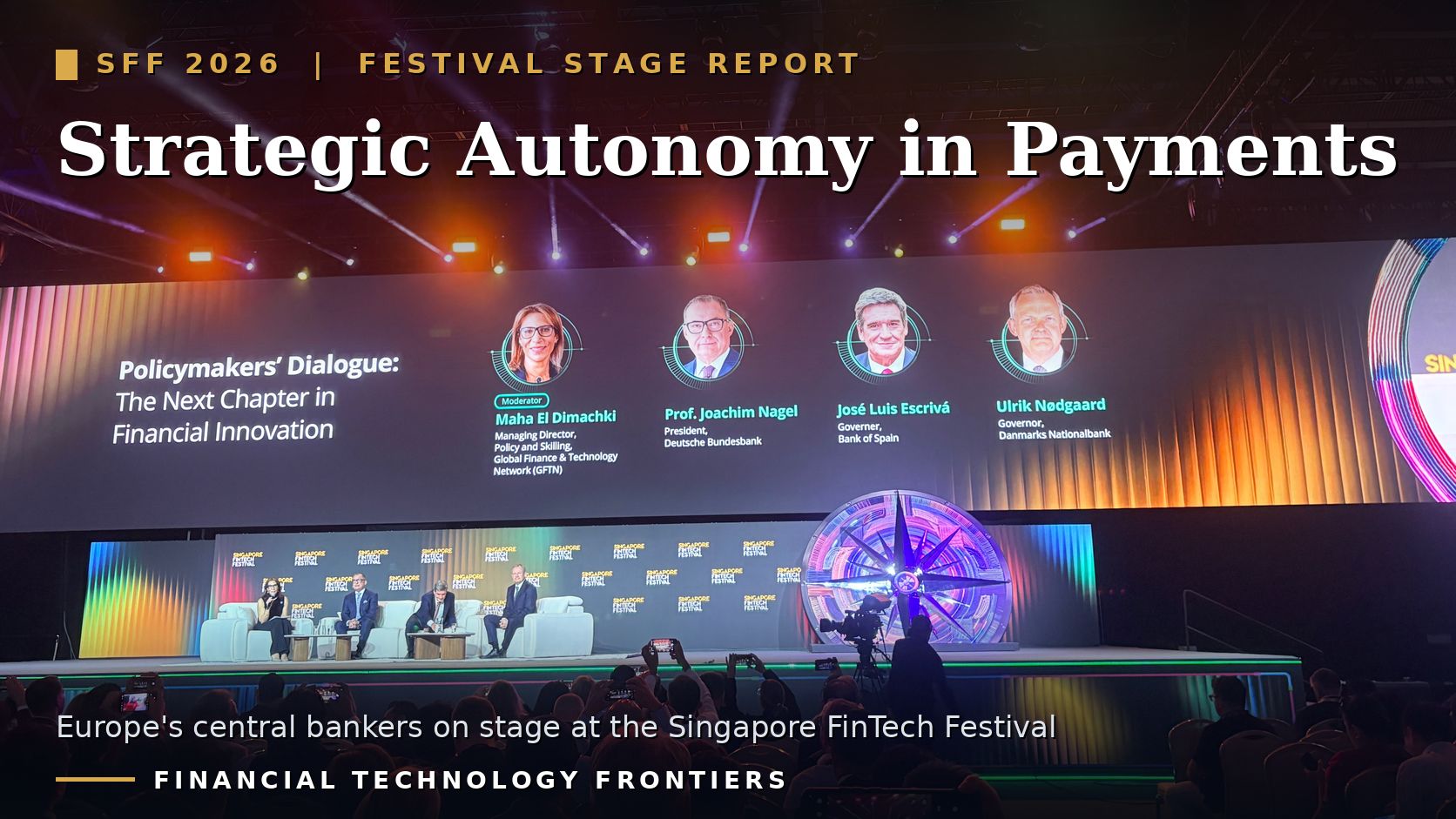
Speaking at the session “Policymakers’ Dialogue: The Next Chapter in Financial Innovation” on the Festival Stage were Joachim Nagel, President of the Deutsche Bundesbank; Ulrik Nødgaard, Governor of Danmarks Nationalbank; and José Luis Escrivá, Governor of the Bank of Spain. The dialogue was moderated by Maha El Dimachki, Managing Director for Policy and Skilling at the Global Finance and Technology Network (GFTN), who framed it against the morning’s keynote on geoeconomics delivered on the same stage.
Sovereignty is about choices, not walls
The panel’s central theme was strategic autonomy, and the governors were careful to define what it does not mean. It does not mean that everything must be built in Europe, they said; it means understanding dependencies, from supply chains and energy to cloud infrastructure, and having credible alternatives. Russia’s war against Ukraine was described as an eye-opener that forced a holistic look at where Europe depends on others.
Nødgaard offered the clearest illustration. Denmark keeps its own currency, pegged to the euro, but in April 2025 it moved krone payments onto the Eurosystem’s TARGET Services, becoming the first non-euro area central bank to settle in both T2 and TIPS. He drew a line between monetary sovereignty and the technical rails beneath it, describing the decision to join the shared European infrastructure as a very pragmatic one, driven by economies of scale and cybersecurity.
An unexpected benefit, he said, was innovation. He recalled that payments used to be called a boring part of banking, and pointed to retail CBDCs and tokenised central bank money as evidence of how much has changed. For a currency area of six million people and a central bank of about 500 staff, building the tokenised future with European colleagues beats staying in isolation, he said.
Resilience means an alternative to the card rails
Nødgaard linked sovereignty directly to retail payments resilience. Denmark’s account-to-account instant payment scheme is widely used for transfers but has not displaced international cards and wallets in physical stores. He said Denmark hopes for a breakthrough next year that would let shoppers tap their phones in supermarkets using a national solution, providing resilience: if the card rails are down, users could switch to the national scheme, or the other way around. He stressed the aim is alternatives, not the exclusion of the international card companies.
The festival’s own session summary screen, curated by the organisers, carried that argument under its “bold” heading: “We hope next year to have a breakthrough where [..] you can tap your phone at the supermarket using a national solution. That would provide resilience. If the card rails are down, you can switch to this or the other way around.”
Central bank money as the anchor
The euro-area governors cast the digital euro as a public good: a digital twin of the banknotes the Eurosystem provides, designed to keep public money relevant in a digital economy. Nødgaard confirmed Denmark is watching closely: the digital euro is being developed in a multi-currency fashion so Denmark could choose to opt in, and the design of its offline functionality could shape Danish thinking, he said.
On tokenisation, Nødgaard said groundbreaking financial innovation should be treated as a public-private partnership: the private sector can do a lot, but at scale central bank money needs to be part of the settlement. The festival’s session summary captured the same view under its “insightful” heading: “We shouldn’t forget how important central bank money can be in a crisis situation.” The Eurosystem’s Pontes platform, which began settling wholesale DLT transactions in central bank money in September, and its longer-term Appia track are the operational expression of that view.
The governors also pushed back on the image of central bankers as conservative by nature, pointing to the EU’s Markets in Crypto-Assets Regulation (MiCA) as an example of Europe setting rules early and arguing that the continent is not behind the curve on innovation.
Can central banks keep up with AI?
Asked whether central banks can keep pace with innovation, Nagel said technology is changing central banking itself. AI is already used in the Bundesbank’s internal models, he said, and it poses questions for monetary policy, including where the neutral rate of interest settles if AI lifts productivity. Europe may not have frontier AI models, he argued, but it holds deep data from its strong industrial base and should take advantage of it. The festival’s session screen carried that argument under its “fresh” heading: “Coming back to Europe, maybe we do not have frontier AI models. But what we have is a lot of data from our strong industrial base and I believe we should take and will take advantage of all this data.”
Escrivá said innovation is being built into the Bank of Spain’s core functions: when authorising new banks and payment institutions, supervisors now weigh the innovative element of applicants’ business models alongside traditional prudential tests. Looking beyond payments, he identified agentic AI in finance as the next test, saying regulations and standards must keep pace with new agents and new ways of making decisions, so that safety and trust in money and financial stability are preserved.
El Dimachki closed the session by rejecting a familiar caricature: the idea that the US innovates, Europe regulates and Asia replicates is, in her view, no longer true.
Reported from the Festival Stage at Singapore EXPO. The session was listed on the festival’s public agenda as an open, pass-access session; this report is based on a partial on-site recording of the discussion. Direct quotations are reproduced from the festival’s own session summary screen.
Sources
- Session: Policymakers’ Dialogue: The Next Chapter in Financial Innovation – Singapore FinTech Festival 2026
- ECB: Danish krone now available in all TARGET Services (23 April 2025)
- Danmarks Nationalbank: Krone payments moved to the pan-European payment system (23 April 2025)
- ECB: TIPS cross-currency service between the euro area, Denmark and Sweden
- ECB: Pontes and Appia – tokenisation and DLT settlement in central bank money
Speakers: Joachim Nagel, Deutsche Bundesbank | Ulrik Nødgaard, Danmarks Nationalbank | José Luis Escrivá, Bank of Spain | Maha El Dimachki, GFTN
Institutions: Deutsche Bundesbank | Danmarks Nationalbank | Banco de España | GFTN