The financial services industry has entered a new phase in its adoption of artificial intelligence. The debate is no longer about whether the technology works. Across banking, payments, insurance and investment management, the real challenge is determining how to convert promising experiments into enterprise-wide capabilities that improve customer outcomes, strengthen resilience and deliver measurable business value.
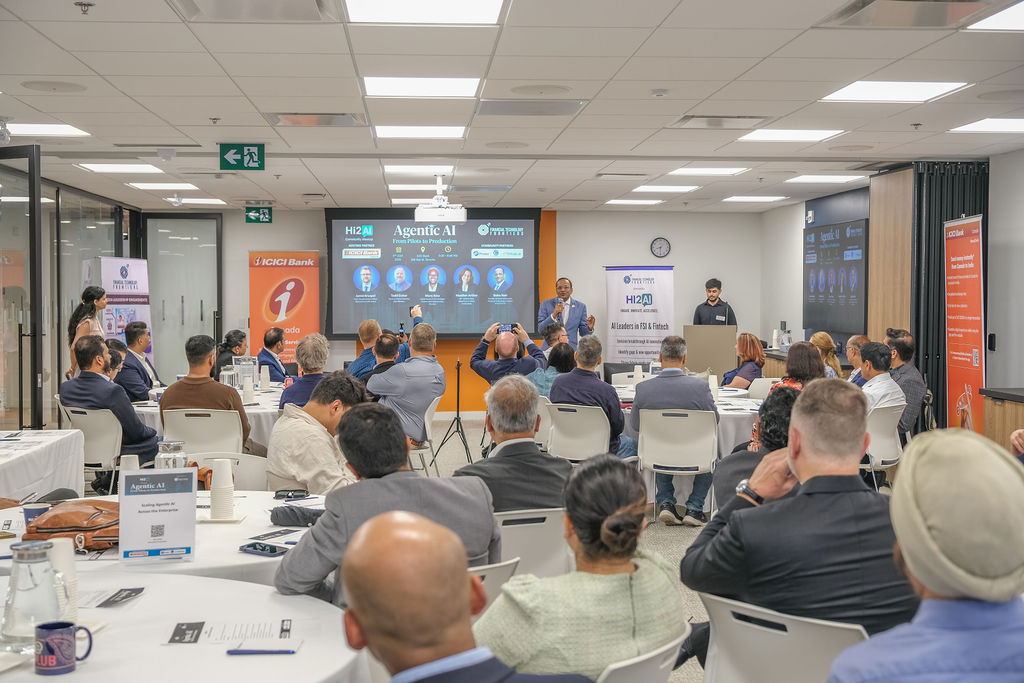
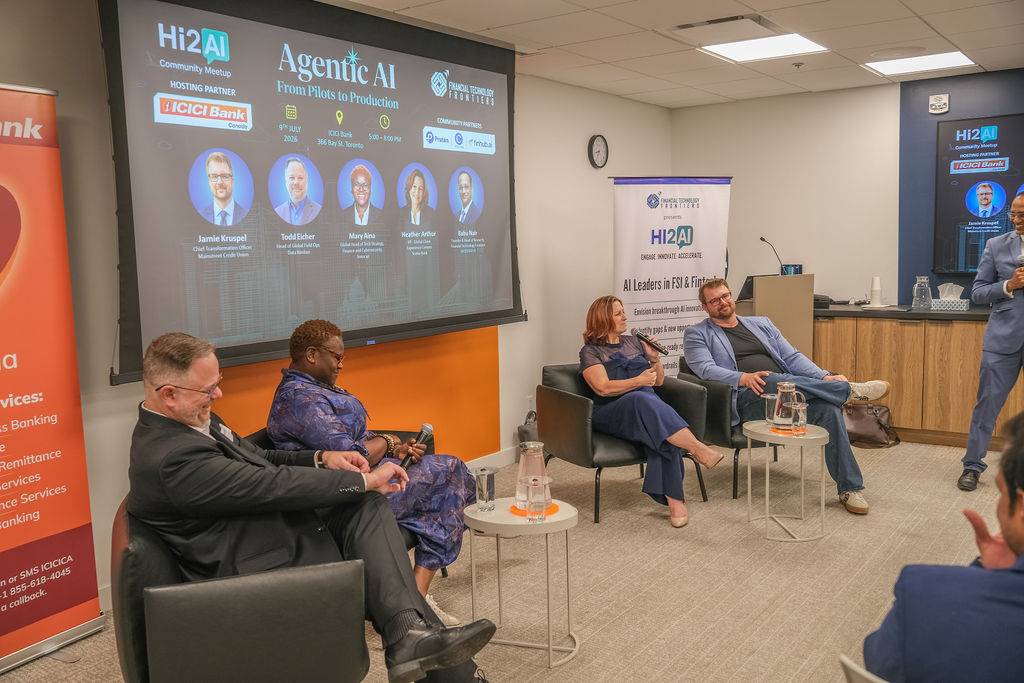
This question formed the centrepiece of a compelling discussion at the Hi2AI Community Meetup, hosted by Financial Technology Frontiers, where senior executives representing banking, credit unions, investment management and enterprise technology shared practical insights from their own organisations.
The panel was moderated by Babu Nair, Founder and Head of Research at Financial Technology Frontiers, and featured Jamie Kruspel, Chief Information Officer, Mainstreet Credit Union; Heather Arthur, Vice President, Global Client Experience Centres, Scotiabank; Mary Aina, Global Head – Technology Strategy, Finance & Cybersecurity, Innocap; and Todd Eicher, Head of Global Field Operations, DataNimbus.
Rather than discussing technology trends, the conversation focused on execution. Leadership, governance, customer trust, workforce readiness and operational discipline emerged as the defining factors separating successful enterprise adoption from isolated innovation initiatives.

Business Value Must Drive Technology Decisions
Opening the discussion, Babu Nair observed that while financial institutions have invested significantly in innovation, relatively few initiatives have progressed beyond pilot projects into enterprise production. He invited the panellists to share what distinguishes successful implementations from those that struggle to scale.
Jamie Kruspel argued that organisations often begin with the wrong question.
“Artificial intelligence should never become the objective,” he said. “The objective is solving a business problem. Once you understand the problem, you can determine whether AI is the right capability to address it.”
For credit unions, that discipline is particularly important. Operating with leaner technology budgets than larger banks while facing similar customer expectations requires careful prioritisation. Kruspel explained that the greatest opportunities frequently lie in improving operational efficiency rather than pursuing highly visible innovation projects.
He described how Mainstreet Credit Union redesigned the way financial advisors prepare for customer meetings. Instead of spending significant time navigating multiple systems and manually gathering customer information, advisors now receive a consolidated briefing generated through integrated enterprise data and intelligent automation.
“The outcome wasn’t about deploying AI,” Kruspel explained. “It was about giving advisors more time to spend with members instead of searching for information.”
The example reflected a broader principle. Across financial institutions, employees continue to spend substantial time transferring information between systems, validating documents and completing repetitive administrative tasks. Reducing those activities creates value for both employees and customers.
At the same time, Kruspel cautioned against allowing technology to replace independent judgement.
“There is a difference between improving productivity and surrendering critical thinking,” he observed. “Every organisation should encourage experimentation, but people must continue to question, evaluate and apply their own judgement.”
Competitive Advantage Will Depend on People, Not Technology Alone
Heather Arthur shifted the discussion towards customer experience and organisational culture.
She challenged the widespread assumption that technology alone will become the defining competitive advantage in financial services.
“Within a few years, every major financial institution will have access to similar technologies,” she said. “The differentiator will not be the technology itself. It will be the people who know how to use it.”
Arthur believes many organisations underestimate the importance of workforce readiness during large-scale transformation. Employees who view technology as a threat are unlikely to embrace new ways of working, regardless of how advanced the underlying systems may be.
“The first investment should be trust,” she noted. “Technology, risk, compliance and human resources have to work together because this is no longer simply a technology initiative. It is an organisational initiative.”
 She encouraged leaders to communicate openly about how roles will evolve rather than attempting to reassure employees that nothing will change.
“Our jobs are going to look different,” she said. “The title may remain the same, but the way we deliver value will change significantly.”
Arthur also argued that many institutions continue to measure success using metrics developed for an earlier era of banking.
Traditional contact centre measures such as average handling time or transaction speed remain important operational indicators, but they do not necessarily reflect customer value.
“As routine activities become automated, the conversations that remain become more important,” she observed. “Those interactions require empathy, curiosity and judgement. Those are the capabilities organisations should now be developing.”
Sharing a personal experience involving a difficult interaction following the loss of her father, Arthur illustrated how scripted customer service can fail during emotionally significant moments. The experience reinforced her belief that technology should remove administrative burdens so employees can focus on conversations where human understanding matters most.
Governance Must Keep Pace with Innovation
Mary Aina brought a governance and cybersecurity perspective to the discussion.
Drawing on experience across banking, insurance and investment management, she argued that organisations should view intelligent technologies not simply as productivity tools but as capabilities that can strengthen enterprise resilience.
One area she believes holds significant promise is autonomous identity and access management, where continuous monitoring, adaptive controls and automated responses can substantially improve cyber resilience.
However, Aina also warned that advances in defensive capability are being matched by increasingly sophisticated threats.
“The reality many organisations are preparing for is one where intelligent systems increasingly interact with other intelligent systems,” she said. “That changes the way we think about resilience.”
Responding to questions around autonomous fraud and intelligent cyber threats, she noted that organisations can no longer rely solely on reactive security models.
“We will never eliminate every threat,” she observed. “Our responsibility is to build organisations that can anticipate, adapt and recover.”
Aina emphasised that governance cannot be treated as an afterthought.
“Technology can accelerate good processes,” she remarked. “It can also accelerate poor ones. Data quality, governance and accountability have to be designed into every implementation from the beginning.”
She encouraged institutions to define success through business outcomes rather than technology adoption.
“The important question isn’t how many tools we’ve deployed,” she said. “The important question is whether we’ve solved the problem we set out to solve.”
Enterprise Deployment Demands Operational Discipline
Representing the payments industry, Todd Eicher focused on the realities of implementing intelligent systems within highly regulated financial environments.
He drew an important distinction between analytical capability and operational execution.
“These technologies are exceptionally good at analysing information, identifying patterns and making recommendations,” he said. “Execution still requires robust governance and well-established operational controls.”
Within payments, he sees immediate opportunities in fraud detection, transaction monitoring, liquidity forecasting, reconciliation and operational decision support.
Equally important, intelligent systems are helping institutions reduce false positives in fraud monitoring, improving customer experience by allowing legitimate transactions to proceed without unnecessary interruption.
One of Eicher’s strongest observations challenged the industry’s continued reliance on traditional proofs of concept.
“The industry no longer needs to prove that AI works,” he said. “The real challenge is whether it performs reliably against production data, production governance and production accountability.”
He explained that many promising initiatives struggle because pilots are developed using carefully prepared datasets that bear little resemblance to the complexity of real operational environments.
“The technology usually isn’t the problem,” he observed. “Data quality and governance are.”
Eicher encouraged organisations to move quickly towards controlled production pilots supported by real enterprise data rather than spending excessive time validating concepts that have already been demonstrated elsewhere.
“Business value, governance and data readiness should come before technology deployment,” he said.
Leadership Defines the Outcome
As the discussion drew to a close, Babu Nair reflected on the common themes emerging across banking, payments, investment management and cybersecurity.
While the technologies may differ across institutions, the leadership priorities remain remarkably consistent.
Successful organisations begin with clearly defined business problems rather than technology initiatives. They prepare their workforce alongside their technology platforms. They invest in governance before scale. They recognise that customer trust remains their most valuable asset. Most importantly, they understand that innovation is measured not by the number of pilots launched, but by the business outcomes delivered.
The discussion underscored that the next chapter of intelligent technology in financial services will not be written by algorithms alone. It will be shaped by leadership teams capable of aligning technology, governance, customer experience and organisational culture into a coherent enterprise strategy.
For financial institutions, the transition from pilots to production has become far more than a technology programme. It is rapidly emerging as one of the defining leadership challenges of the decade.