
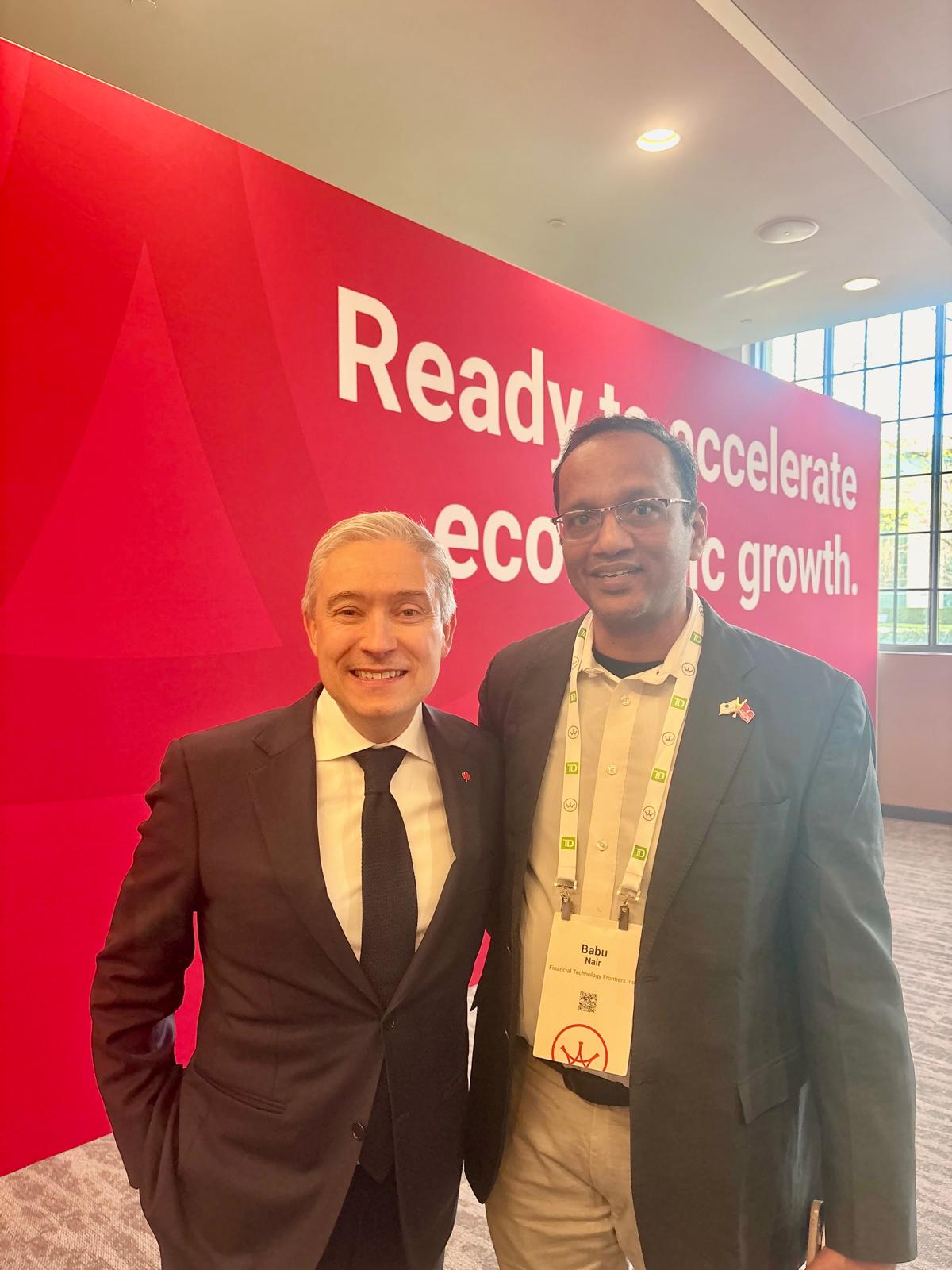
 Reflections from Minister Francois -Philippe Champegene
Canada’s Payments Future and Economic Resilience: Reflections from François-Philippe Champagneat the Payments Canada Summit in a fireside chat with Susan E. Hawkins, President and CEO of Payments Canada, at The 2026 Payments Canada SUMMIT
By Babu Nair- Founder and Head Research- Financial Technology Frontiers.
The Payments Canada Summit brought together policymakers, financial institutions, fintech leaders, regulators, payment innovators, and technology companies during a period of significant transition for the global financial ecosystem. Discussions throughout the summit focused on payments modernization, digital infrastructure, cybersecurity, artificial intelligence, financial resilience, and Canada’s broader role in the evolving digital economy.
One of the central conversations at the summit featured François-Philippe Champagne, whose remarks extended beyond payments modernization to address questions of economic resilience, innovation policy, financial crime, talent, and Canada’s international competitiveness.
The discussion reflected a consistent message: Canada possesses strong institutional foundations, research capabilities, and innovation talent, but future success will depend on the country’s ability to modernize infrastructure, scale innovation, strengthen resilience, and compete with greater confidence globally.

Canada’s Position in the Global Digital Economy
Champagne began by highlighting the level of engagement at the summit and the increasing international attention being directed toward Canada’s payments and innovation ecosystem. Referring to the “great energy” at the event, he pointed to the strong international participation and suggested that Canada is increasingly being viewed as a credible source of innovation and operational best practices in payments and financial technology.
A recurring theme throughout the discussion was the importance of trust in the future digital economy. Champagne emphasized that trust, governance, and reliability are becoming increasingly important as countries and businesses adopt new payment systems, digital infrastructure, and emerging technologies. He argued that Canada’s reputation as a trusted partner could become an important strategic advantage as the global financial ecosystem continues to evolve.
Payments Modernization and Digital Infrastructure
A major focus of the summit was Canada’s ongoing payments modernization agenda and the broader role payment systems are expected to play in the future economy.
Champagne emphasized the need to modernize payment infrastructure across consumer, business, and cross-border ecosystems as commerce becomes increasingly digital and interconnected.
The discussions reinforced that payment infrastructure is no longer viewed simply as a banking utility, but increasingly as foundational digital infrastructure supporting commerce, innovation, competition, and economic resilience.
Particular attention was given to Canada’s Real-Time Rail (RTR) initiative, which was repeatedly referenced as a central component of the country’s financial modernization efforts. Participants discussed the potential for real-time payments to improve business efficiency, reduce friction in transactions, support fintech innovation, and enable new digital business models across the financial ecosystem.
The fireside discussion also reflected growing recognition that payment systems are increasingly tied to economic security and national resilience.
The discussion further reflected the growing view that payment systems are becoming an important component of national economic resilience.
International Collaboration and Canadian Innovation
One of the recurring themes during the fireside discussion was the importance of learning from international models while continuing to strengthen domestic innovation capabilities.
Champagne referenced his recent visit to India and pointed to developments in real-time payments and digital infrastructure.
Champagne referenced his recent visit to India, highlighting the rapid development of real-time payment systems and noting that there is significant value in learning from international models and best practices.
At the same time, he emphasized the importance of building globally competitive solutions from within Canada’s own innovation ecosystem.
At the same time, he emphasized the opportunity for Canadian companies and innovators to build globally competitive solutions from within Canada’s own ecosystem.
The discussion also focused on the strength of Canada’s academic and research ecosystem.
The discussion also focused heavily on Canada’s research and talent ecosystem, particularly the strength of its universities, technical expertise, and innovation capacity.
Champagne also encouraged a stronger sense of national ambition and confidence.
Champagne also spoke about the need for greater national ambition and confidence as Canada competes in the global digital economy.
He described the future in terms of “ambition with confidence, with vision.”
Innovation, AI and Commercialization
The summit conversations also focused on the growing importance of innovation-led economic growth, particularly in areas such as artificial intelligence, quantum technologies, software, and intellectual property.
A broader theme throughout the summit was the transition toward an economy increasingly driven by innovation, ideas, software, and intellectual property.
Champagne framed Canada not only as a resource economy or manufacturing nation, but also as a country with the potential to become a global innovation leader.
Champagne suggested that Canada should increasingly view itself not only as a resource and industrial economy, but also as an innovation-driven economy with global potential.
The discussions also touched on Canada’s early leadership in emerging technologies.
The discussion also referenced Canada’s early leadership in artificial intelligence policy and strategy.
Quantum technologies were similarly discussed as areas where Canada has established an early strategic foundation.
Alongside these strengths, the discussion also acknowledged the importance of commercialization, intellectual property protection, and scaling Canadian innovation globally.
There was also discussion around the importance of protecting intellectual property and ensuring that Canadian innovation creates long-term economic value domestically.
The summit repeatedly reinforced the idea that Canada’s future competitiveness will depend not only on generating innovation, but on building ecosystems capable of scaling that innovation internationally.
Financial Crime and the Evolving Security Environment
One of the most important parts of the fireside discussion focused on financial crime, cybersecurity, and the rapidly evolving risk environment created by AI, cyber threats, and emerging technologies.
Champagne spoke strongly about the government’s focus on financial crime prevention and the creation of a dedicated financial crime agency.
A significant portion of the fireside discussion focused on financial crime, cybersecurity, and the evolving threat landscape facing modern financial systems.
He emphasized that financial crime enforcement today is fundamentally different from traditional policing models.
Champagne described financial crime enforcement as “policing of the 21st century,” reflecting the increasingly digital and cross-border nature of financial threats.
The discussion highlighted how modern financial crime increasingly intersects with AI, cyber threats, cryptography, cross-border intelligence, and quantum technologies.
He noted that emerging technologies such as AI, quantum computing, and cyber capabilities are rapidly changing the complexity of financial crime and fraud prevention.
Champagne noted that building a modern financial crime capability will require expertise across multiple disciplines.
The conversation highlighted the growing need for expertise across areas such as cryptology, AI, quantum technology, and forensic accounting.
The discussion also reflected broader concerns around fraud prevention and protecting vulnerable Canadians.
The discussion also touched on fraud prevention and protecting vulnerable Canadians from increasingly sophisticated financial scams.
The discussion reflected the growing complexity of the digital financial ecosystem and the need for stronger coordination between innovation, cybersecurity, fraud prevention, and regulatory resilience.
Economic Security and Digital Sovereignty
Another major theme throughout the fireside chat was the growing connection between economic security, national security, and financial infrastructure.
Champagne discussed the need to modernize legislative frameworks to ensure that Canada has the tools necessary to protect critical systems and economic resilience.
Another important theme was the growing relationship between economic security and national security.
He explained that governments globally are increasingly focused on resiliency across critical infrastructure sectors, including banking, payments, telecommunications, energy, and digital systems.
Champagne noted that governments globally are placing increasing emphasis on resilience across critical infrastructure systems.
The discussion reflected how global geopolitical uncertainty, supply chain disruptions, cyber risks, and technological dependencies are reshaping national policy priorities.
The discussion reflected broader international concerns around building resilient systems capable of adapting to geopolitical, technological, and economic disruption.
The conversation also reflected broader concerns around resilience across critical infrastructure and the importance of maintaining appropriate safeguards within the financial system.
At the same time, he emphasized the importance of balancing innovation and competition with safeguards designed to protect economic resilience and national interests.
The summit discussions made it increasingly clear that future conversations around payments modernization will also involve questions of sovereignty, resilience, cybersecurity, and economic security.
Canada’s International Role in Digital Finance
One of the more forward-looking ideas discussed at the summit was the concept of building stronger international digital collaboration platforms and positioning Canada more prominently in global payments and fintech conversations.
The fireside discussion also explored the possibility of deeper international collaboration through digital-focused trade and innovation initiatives.
The idea reflects the reality that future trade and economic growth will increasingly revolve around digital services, AI systems, fintech infrastructure, cybersecurity, APIs, Data engineering and more.
The energy of the minister and his passion to get things done were a strong confidence to the ecosystem that the best of the time for the Canadian innovations and for the financial services will come soon. Looking forward to the next edition- Payments Canada 2027.