At its Insights2040 Annual Meetings, the Global Finance & Technology Network (GFTN) told an invite-only gathering of central banks, regulators and financial institutions that five forces — technology, geoeconomics, capital, talent and policy — are reshaping global finance simultaneously. The warning was accompanied by a new report on tokenized markets, examining why the sector remains caught between pilot programmes and large-scale adoption, alongside a series of initiatives that GFTN says are already translating ideas into action.
An invite-only start to Singapore FinTech Festival week
The Insights2040 Annual Meetings opened on 16 November at the Sands Expo and Convention Centre in Singapore and run for two days. Previously known as the Insights Forum, the event is the annual culmination of Insights2040, GFTN’s year-round platform focused on building an evidence base and practical implementation pathways for a more efficient, resilient and inclusive financial system. It also marks the start of Singapore FinTech Festival week.
The event page describes a deliberately senior gathering, with more than 4,800 delegates, 81% of whom are in senior leadership positions, alongside more than 240 central banks and regulators. The programme features over 50 roundtables, workshops and launchpads across the two days. Signature roundtables and boardroom discussions are being held under Chatham House Rules.
Five fronts, one deadline
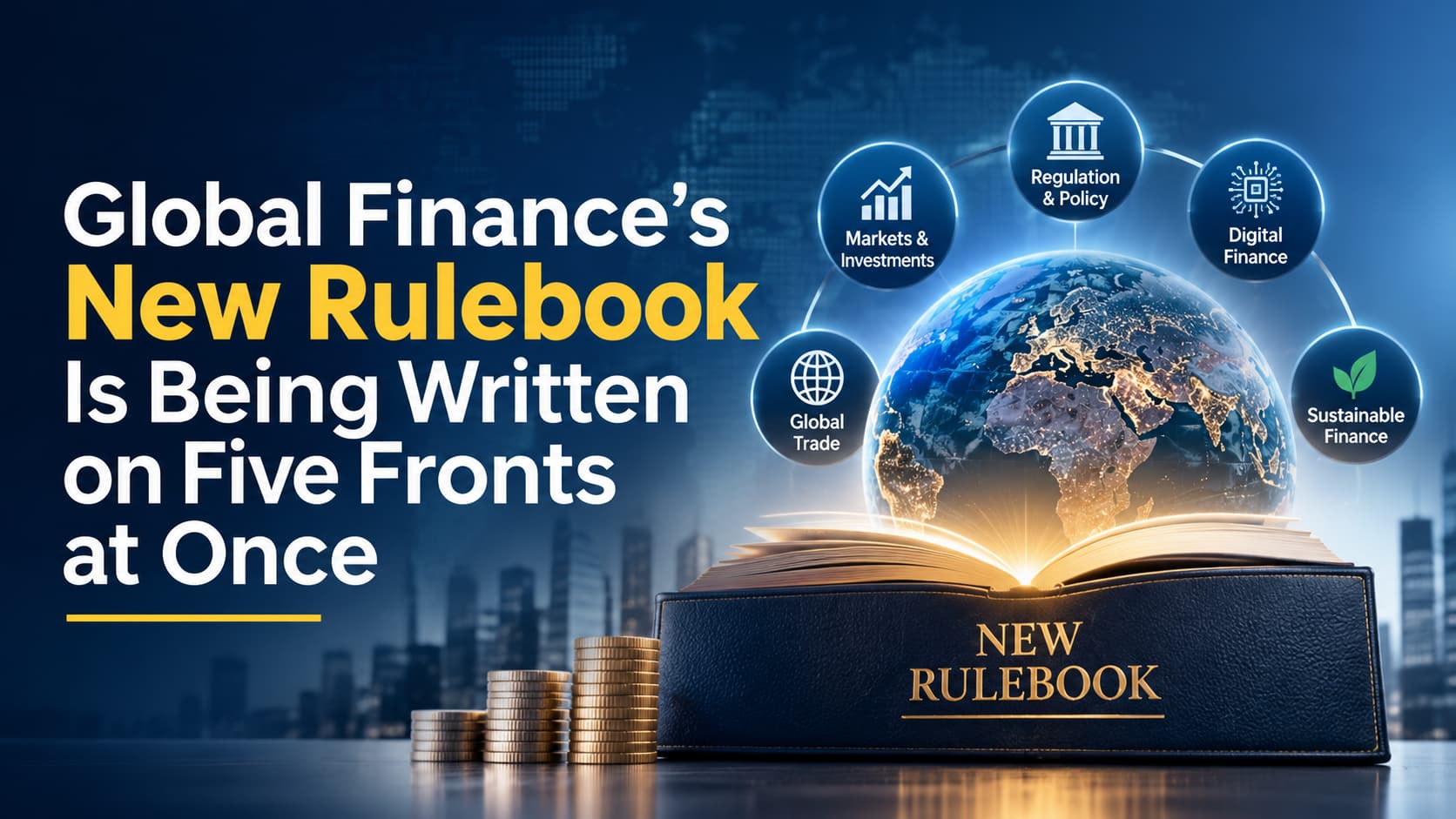
The opening address was delivered by Anthony Thomas, GFTN’s Group Chief Operating Officer, and Maha El Dimachki, Managing Director for Policy and Skilling. Their central argument was clear: global finance is approaching a new rulebook, and it is being rewritten across five fronts at once.
Technology: The address paired technological opportunity with an expanding threat landscape. Nearly $21 billion in cybercrime losses were reported to the FBI last year, an increase of more than a quarter in a single year. The FBI’s annual report also includes a dedicated section on AI for the first time, the address said, citing the FBI’s 2025 Internet Crime Report. Meanwhile, the global tokenized asset market is estimated to reach $5.5 trillion by 2030, according to Citi Institute figures cited in the address. It also noted that the European Union has asked member states to begin transitioning to post-quantum cryptography by the end of this year.
Geoeconomics: Trade between developing economies now accounts for nearly 28% of global merchandise trade — almost twice its share of 20 years ago — according to figures from the World Trade Organisation. The address argued that the financial and settlement networks supporting this trade must evolve alongside it.
Capital: AI-connected firms now account for around 45% of the S&P 500’s market capitalisation, while the largest technology companies are expected to spend approximately $670 billion on capital expenditure this year, according to figures cited in the address.
Talent: The World Economic Forum’s Future of Jobs Report projects that employers expect 39% of workers’ core skills to change by 2030.
Policy: The address highlighted a statistic that framed the week’s discussions. Citing a study by FT Longitude, SAS and Microsoft, it noted that 82% of banks use generative AI, but only 18% have fully operational, embedded governance processes for AI models.
Six themes, one test
The programme is organised around six themes, each tied to a defined outcome:
- Accountability and Liability in Agentic Systems: Defining how responsibility is assigned across the value chain as AI systems begin to act, rather than simply advise.
- The Scaling Challenge in Tokenized Markets: Establishing clarity around shared settlement assets, legal finality and secondary-market depth.
- Shaping Tomorrow’s Innovation: Developing investment and market-entry pathways while addressing gaps in technology and skills access for emerging economies.
- Global Frameworks and Shared Best Practices in Payments Chains: Encouraging cooperation and alignment across jurisdictions.
- Sovereignty and Resilience in a Rewired Financial System: Building roadmaps for strategic autonomy and greater financial-system resilience.
- Preparing Finance for the Quantum Era: Turning post-quantum guidelines into credible migration plans and moving early pilots towards deployable use cases.
El Dimachki set a common test for every session: did the discussion move from insight to action?
What GFTN says is already moving
The centrepiece launch on opening day was a report titled “Tokenized Markets: Practical Implementation Pathways for Authorities Considering Tokenization”. It identifies eight frictions that private-sector firms say are keeping tokenized markets between pilot and production. Its central finding is institutional rather than technical: in seven of the eight areas, the main obstacle is coordination between authorities. Where mandates overlap, each authority may wait for another to act; where gaps exist, responsibility can remain unassigned.
The report is equally candid about the state of the market. Close to half of tokenized real-world asset value, excluding stablecoins, is held in government debt, largely US Treasury funds. Even these instruments see limited secondary-market trading after issuance. The report’s underlying point is that a token’s value depends on its practical utility — who is willing to buy it, lend against it or accept it as collateral, what form of money supports the transaction, and which rules govern it.
The report is accompanied by a Tokenization Pathways Toolkit, which guides authorities from a firm’s proposal towards one of five possible decisions, ranging from support to decline. Each decision is linked to a named owner, the evidence required and a review date. GFTN plans to extend this work through a capacity-development programme at next year’s Point Zero Forum in Zurich, alongside a digital sandbox.
In payments, GFTN is working with the Latin American Reserve Fund (FLAR) on Project Lúmina. The initiative brings together the central banks of Chile, Colombia, Paraguay, Peru and Uruguay to explore connections between their instant payment systems, drawing on lessons from Project Nexus.
In Africa, GFTN has published a digital public infrastructure gap assessment for Namibia and is working with the Ghana Interbank Payment and Settlement Systems (GhIPSS) and partners across the region.
On AI governance, GFTN is working with the ASEAN Bankers Association and partners to establish a baseline for AI governance in banking. It is also collaborating with Financial Innovation for Impact on how regulators can use AI in their own supervisory functions. Meanwhile, the methodology for the Fintech Regulatory Futures Index, announced in June with The Fintech Foundation, has been released for review.
On talent, the first BharatNetra cohort in Odisha, run in partnership with the state government and the National University of Singapore’s Asian Institute of Digital Finance, has graduated. More than 60 graduates have already secured internships or job offers. One student team took its capstone project from Odisha to Tokyo, presented it to MUFG and received funding to develop the idea further.
On quantum technology, the Q-FINEX platform, developed with the University of Western Australia and ST Engineering, aims to give financial institutions a practical environment to test quantum and hybrid approaches against real business challenges.
The conversations in between
GFTN’s Day 1 post captured the atmosphere the organisation is seeking to foster: “The sessions set the agenda. The conversations in between move it forward…” It described the value of bringing the FinTech community together as an opportunity to put policy and practice into the same conversation.
The address closed by borrowing a line from European Central Bank President Christine Lagarde: “There is no pre-existing playbook for the situation we are facing today, and so our task is to draw up a new one.” Whether the week’s conversations become the foundation for that playbook is the question that the rest of Singapore FinTech Festival week will carry.
FTF Analysis
The following is Financial Technology Frontiers’ interpretation, separate from the facts reported above.
The number to watch is the 82/18 split. Banks are adopting generative AI considerably faster than they are building the governance frameworks needed to supervise it. The focus on accountability in agentic systems suggests that regulators may increasingly ask who is liable when AI takes action, rather than simply provides advice. Institutions able to demonstrate embedded model governance — not just AI features — could turn this gap into a commercial advantage in supervisory discussions.
The tokenization report’s broader message is that technology is no longer the only, or even the principal, constraint. If seven of the eight identified frictions stem from coordination between authorities, progress will depend on individual authorities being willing to make decisions, one framework at a time. The toolkit is intended to make those initial decisions safer and more structured. Whether the Zurich capacity programme and digital sandbox become practical resources for market participants will be worth watching into 2027.
Project Lúmina also deserves attention beyond Latin America. If five central banks can connect their instant payment systems by applying lessons from Project Nexus, the initiative could offer a useful model for other regions. This is particularly relevant to markets building or upgrading real-time payment infrastructure and exploring how domestic systems can connect without recreating correspondent banking on a new technology stack.
One note of caution remains: many of the week’s substantive sessions are held under Chatham House Rules. The public test of the stated ambition — moving from “insights to action” — will therefore be what emerges in the months ahead. The opening day delivered a report, a toolkit and a set of named initiatives. Their real measure of success will be the outcomes they produce.