
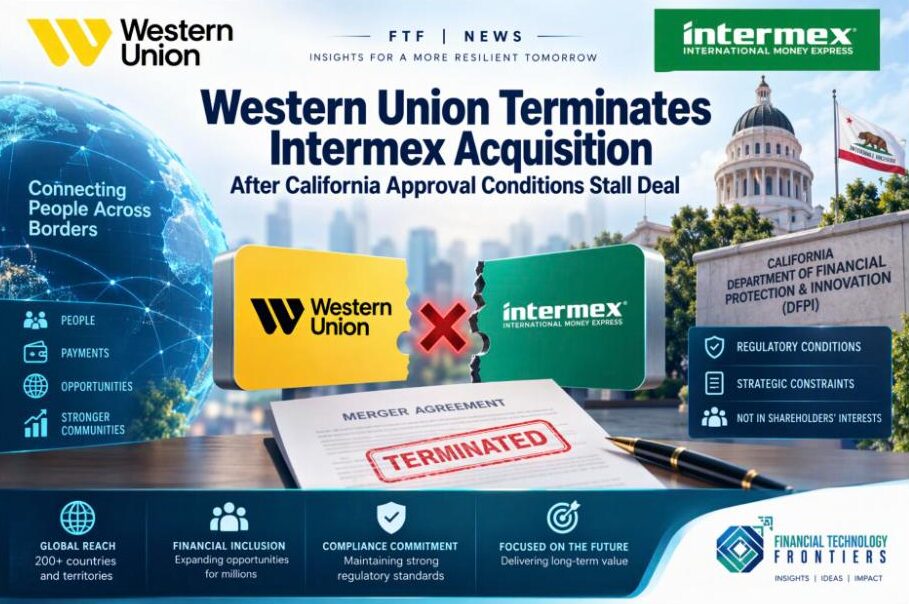
Western Union has walked away from its planned acquisition of International Money Express (Intermex) after California’s financial regulator issued final approval conditions the company said would have required significant changes to its business model, agent relationships and long-term strategy.
Western Union (NYSE: WU) has terminated its planned acquisition of International Money Express, Inc. (Intermex) (NASDAQ: IMXI), ending a transaction that had spent more than a year navigating regulatory approvals across multiple jurisdictions.
The decision follows a breakdown in the approval process with California’s Department of Financial Protection & Innovation (DFPI), which Western Union said imposed final approval conditions that would have required significant changes to the company’s business model, agent relationships and long-term strategic direction.
California: the last approval standing
According to Western Union, the acquisition had already received approval from every other relevant jurisdiction, including regulatory clearances across several U.S. states, territories and foreign jurisdictions, merger clearance in the United States and change-of-control approvals in the United Kingdom and Spain. California remained the sole outstanding approval required to complete the transaction.
Western Union stated that the DFPI initially approved the transaction in February 2026 and subsequently granted extension requests in April and July. However, the regulator later withdrew its previous approval and, on November 10, issued final conditions that Western Union considered unacceptable.
The company emphasized that the disagreement was not related to deficiencies in its compliance framework. According to Western Union, California regulators did not identify failures relating to fraud prevention, anti-money laundering obligations, fair market access or the company’s compliance with its consent order obligations involving the Federal Trade Commission.
After reviewing the matter with management, legal counsel and financial advisors, Western Union’s Board of Directors concluded that terminating the merger agreement was in the best interests of the company and its shareholders.
Commenting on the decision, Devin McGranahan, President and Chief Executive Officer of Western Union, acknowledged the efforts invested in the transaction but defended the company’s decision to walk away from the deal.
“We appreciate the significant effort of the teams at Western Union and Intermex who worked diligently for over a year to pursue the transaction. While we are disappointed that we were unable to complete the acquisition on terms that were acceptable to Western Union, we believe this course of action is in the best interests of the company and its shareholders. We remain focused on executing our strategy and delivering long-term value for our customers, shareholders and other stakeholders.”
— Devin McGranahan, President and Chief Executive Officer, Western Union
What the termination means
The termination closes what many viewed as a strategically important transaction within the cross-border remittances sector. Intermex has established a strong position in North American money transfer corridors, particularly within communities that rely heavily on cross-border remittance services. Combined with Western Union’s extensive global network spanning more than 200 countries and territories, the acquisition could have further strengthened Western Union’s position in the global money movement and payments market.
Importantly, the termination does not trigger any breakup-related financial obligations. Under the terms of the merger agreement, neither Western Union nor Intermex is required to make a payment to the other party as a result of the transaction’s termination. The outcome highlights the growing influence of regulatory authorities over consolidation within the financial services sector and demonstrates how a single jurisdiction can ultimately determine the fate of a multinational transaction, even after widespread regulatory approval elsewhere.
For Western Union, attention now shifts back to executing its standalone growth strategy, expanding digital financial services, strengthening its cross-border payments capabilities and continuing its mission of providing accessible financial services to consumers, businesses, financial institutions and governments worldwide. The company indicated it remains committed to maintaining robust compliance programs while delivering long-term value to customers, shareholders and other stakeholders despite the collapse of the Intermex transaction.
Financial Technology Frontiers Analysis
Analysis, distinct from the reported facts above.
What this could mean for customers and agents
In the near term, little changes for senders and recipients: Western Union and Intermex continue to operate as separate networks, and the US-to-Latin America corridors where Intermex is strongest remain contested by two competitors rather than consolidated under one. For agent retailers that work with either brand, the end of the deal removes the prospect of network rationalisation that typically follows a combination of this kind.
What this could mean for the wider ecosystem
The episode is a reminder that money transmission in the United States is licensed state by state, and that a change of control needs every relevant licence to follow. Acquirers in remittances and payments may now build longer timelines, and more room for state-specific conditions, into deal planning — particularly where the target has a large presence in a single state’s customer base.
Open questions
- Conditions: neither company nor the regulator has published the specific conditions that Western Union rejected, which leaves their substance and scope unclear.
- Capital: Western Union’s quarterly filing described the deal as a purchase for approximately $500 million in cash; how the company now deploys that capacity is not yet known.
- Intermex’s path: what Intermex does next as a standalone company, or with another partner, has not been set out in the termination announcement.
What this announcement cannot establish is how the DFPI viewed the transaction or whether the conditions could have been renegotiated; it reflects Western Union’s account of the outcome.