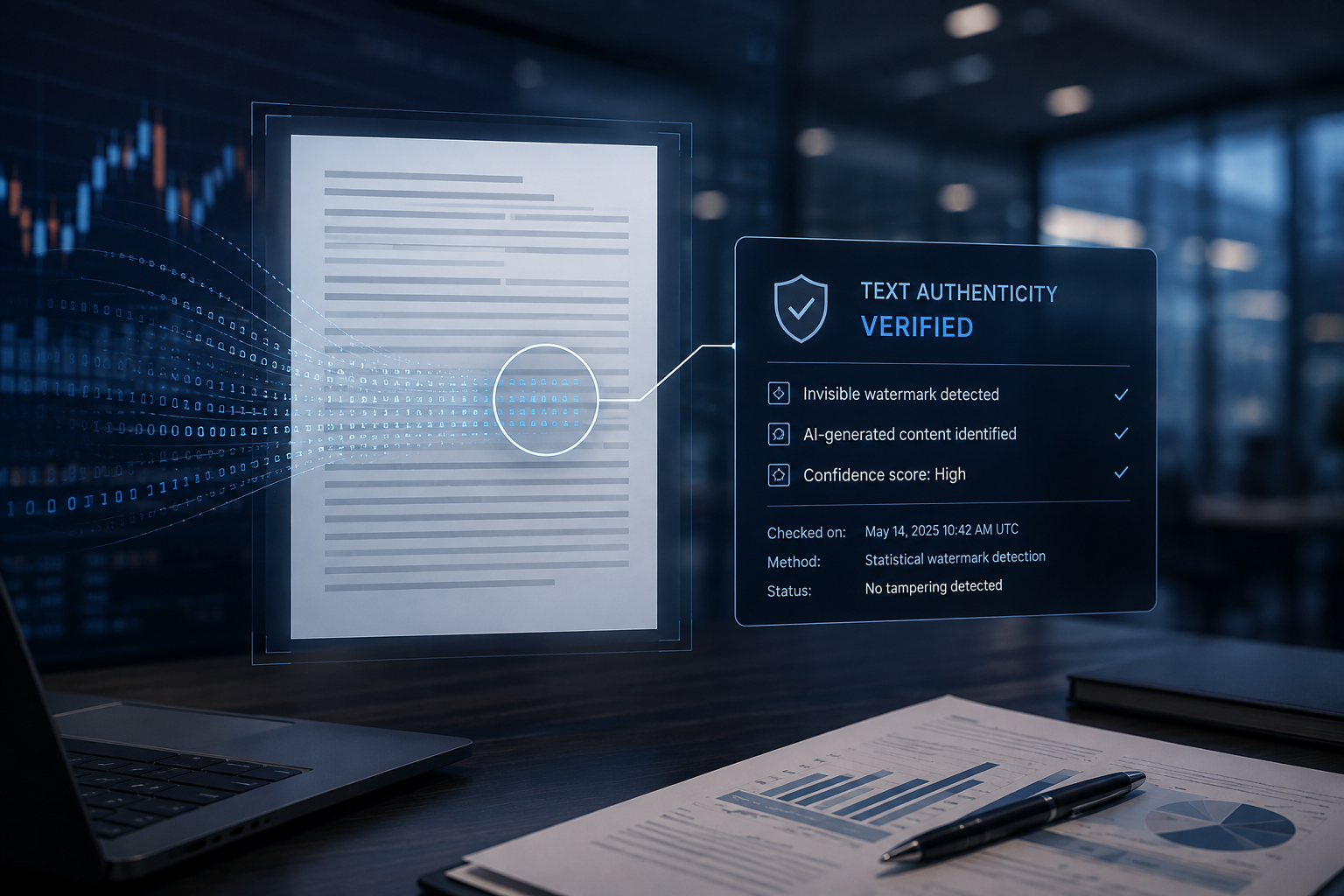
 Anthropic is introducing invisible watermarks in text generated by future Claude models, giving organizations a new way to assess whether Claude was involved in producing content. The move comes as AI transparency requirements under the EU AI Act take effect.
Anthropic said the watermark will be embedded statistically during text generation rather than through visible markings, hidden characters or additional content. The system uses low–stakes word choices to create a pattern that can later be checked using a detection key. The company said the technology has no practical impact on output quality, creativity or readability, adds no tokens and should have a negligible effect on model speed. It also does not contain information that can identify a user, organization or individual Claude conversation.
The watermark is not, however, definitive proof that Claude wrote a piece of content. It can indicate that Claude was likely involved but cannot distinguish between original generation and substantial editing. Detection is also less reliable for short passages, factual material, proofreading and code, where there are fewer opportunities for the model to make flexible word choices.
Anthropic said it is implementing the technology globally to comply with the EU AI Act’s transparency requirements, which took effect Aug. 2, 2026. The European Commission requires machine–readable marking that can help identify AI–generated or manipulated content in relevant circumstances.
Anthropic plans to release a watermark detection API. For supported files such as images, Claude will instead use cryptographically signed C2PA provenance metadata.
- Claude’s future text outputs will carry invisible statistical watermarks.
- The technology is designed to support AI–content provenance without identifying users.
- Detection has important limitations, particularly for short, factual or lightly edited text.
- Anthropic is rolling out watermarking globally amid EU AI Act transparency requirements.
- A detection API is planned, while files will use C2PA credentials.