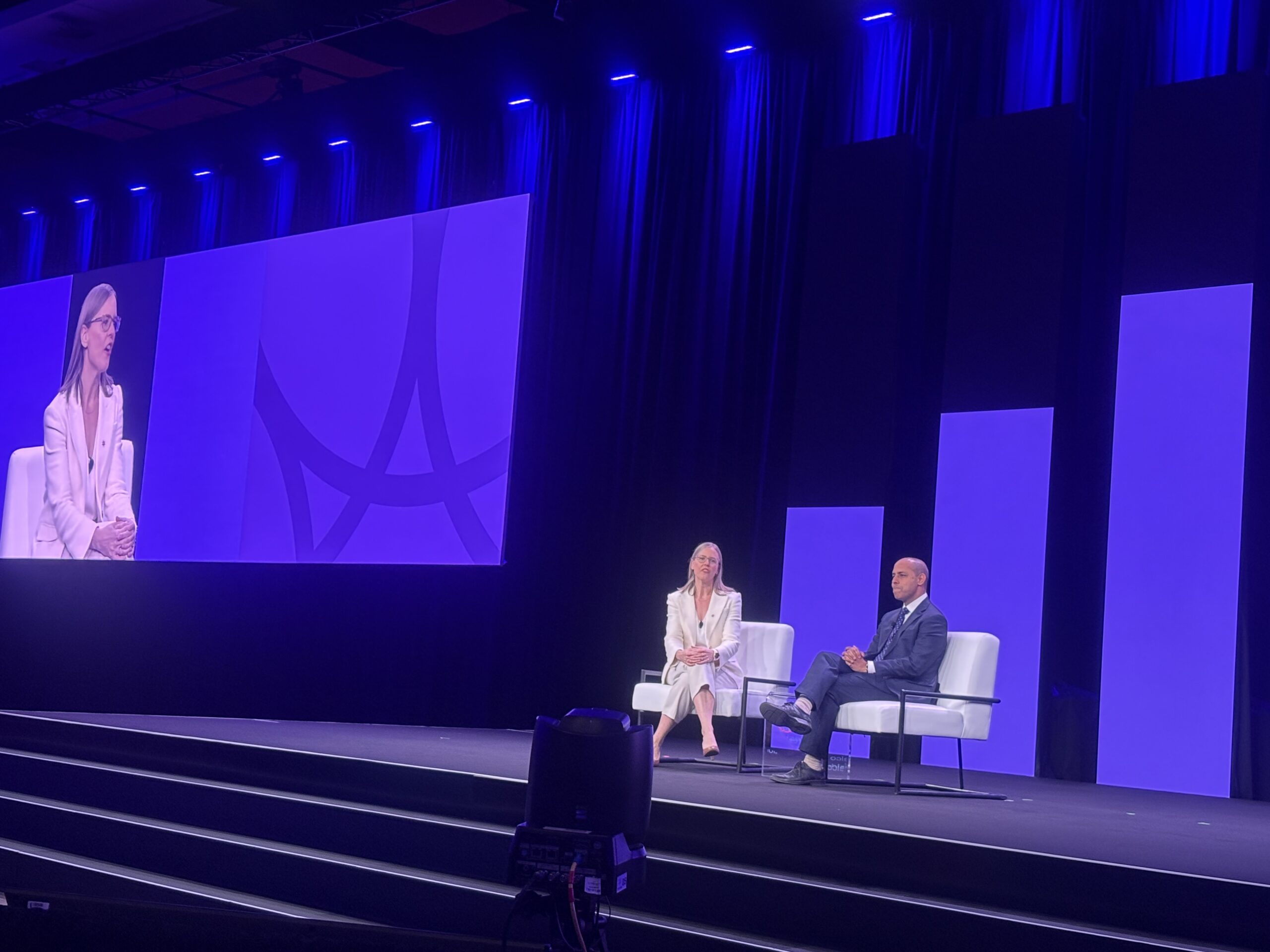

At the Payments Canada Summit, a thoughtful and strategically important conversation unfolded between Vivek Dwivedi, Regional Head – North America at Infosys, and Kristina Logue, CFO of Payments Canada, on the evolving realities of AI-led transformation in financial services. Rather than focusing on AI as a technology trend alone, the discussion explored a deeper challenge confronting enterprises today — how organizations reconcile exponential technological capability with the far slower pace of human adaptation, institutional trust, and cultural change.
Dwivedi described transformation as a continuous state for modern enterprises rather than a one-time initiative. In his view, AI has dramatically altered both the pace and economics of enterprise modernization. “The speed of transformation has advanced exponentially,” he noted, pointing to how large banking and payments transformation programs that once required years of execution and massive financial commitments can now move faster with stronger and more measurable returns.
For organizations facing mounting pressure to modernize legacy systems while balancing cost and regulatory accountability, that shift is significant. Faster deployment cycles and clearer ROI models are making enterprise-scale transformation more achievable and easier to justify at the executive level.
Yet the discussion quickly moved beyond efficiency metrics and technology optimism. Logue brought attention to the human dimension of transformation, highlighting that while AI may unlock new operational possibilities, organizations still need to bring people along through the journey. That observation became central to the discussion.
Dwivedi acknowledged that the biggest barriers to AI adoption are often not technical limitations, but organizational resistance, workforce anxiety, and the inability to build confidence in new systems. “People are unable to adopt because they are unable to trust,” he said, capturing one of the defining tensions now emerging across enterprises globally.
The conversation reflected a growing concern within financial services that AI capabilities are advancing much faster than organizational readiness. While technology adoption curves continue to accelerate, many enterprises are discovering that value realization weakens when employees struggle to adapt to new workflows and decision-making models. As Dwivedi observed, “The ROI falls through when the adoption is falling behind the technology curve.”
That challenge becomes even more pronounced in regulated industries such as banking and payments where trust, governance, explainability, and accountability are foundational requirements. The discussion emphasized that AI transformation cannot succeed through technology deployment alone. It requires organizations to rethink leadership, workforce enablement, and operational governance at the same pace as technical modernization.
One of the most compelling aspects of the session was its focus on the changing nature of talent itself. Dwivedi explained that organizations are no longer evaluating technical professionals solely on their ability to write code. Increasingly, the more valuable capability lies in judgment — the ability to evaluate AI-generated outputs, identify risk, understand regulatory implications, and guide systems responsibly.
In one of the session’s most striking observations, he remarked that “implementation has become cheap, but the cost of bad judgment has become extremely costly.” The statement captured a profound shift now unfolding across technology-led enterprises. As AI lowers the barriers to execution, the strategic differentiator is becoming human oversight, contextual thinking, and the ability to make sound decisions in increasingly automated environments.
The implications for financial institutions are substantial. As AI becomes more deeply integrated into customer experience, fraud management, compliance operations, and enterprise workflows, organizations will face growing pressure to ensure that systems remain fair, unbiased, transparent, and regulator-ready. Human judgment, the discussion suggested, is becoming more important — not less — in the age of intelligent systems.
The conversation also offered insight into how large enterprises are approaching workforce transformation at scale. Infosys, with its workforce of approximately 400,000 employees globally, has reportedly analyzed roles and workflows across multiple personas to better understand how AI intersects with day-to-day operations and organizational processes. The exercise reflects a broader realization taking shape across industries that AI transformation is not merely about automating work, but redesigning how work itself is structured and governed.
For Canada’s banking and payments ecosystem, the discussion carried broader strategic relevance. The country’s financial sector is simultaneously pursuing modernization, operational resilience, innovation, and regulatory discipline. AI may accelerate each of those ambitions, but the session made clear that sustainable transformation will ultimately depend on leadership maturity, workforce adaptability, and an organization’s ability to build trust alongside innovation.
Rather than positioning AI as a replacement for human capability, the discussion presented a more balanced and ultimately more credible vision of the future — one where competitive advantage belongs to organizations capable of combining intelligent systems with thoughtful leadership, responsible governance, and human judgment.