
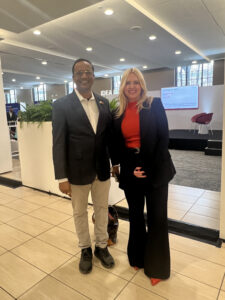
Speaker : Erin Elofson- Country Head, Mastercard- Canada.
Inputs by Babu Nair- Head Research and Alix Moghadam – content Advisor, Financial Technology Frontiers.
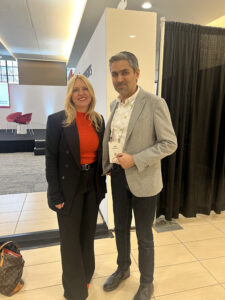 At the Payments Canada Summit 2026, Erin Elofson, Country Manager for Mastercard in Canada, delivered a message that cut through much of the usual industry conversation around faster payments and digital modernization. Her argument was simple but important: speed alone is no longer enough. The real future of payments will be shaped by intelligence, trust, and the ability to make decisions in real time.
 Speaking with a mix of optimism and urgency, Elofson described Canada as standing at a pivotal moment in its payments evolution — one where infrastructure, AI, cybersecurity, and economic resilience are becoming deeply connected.
“As a proud Canadian, my whole career’s been in Canada. I am so, so passionate about this moment,” she said.
Her keynote moved beyond the technical discussion of payment rails and real-time systems. Instead, it focused on what happens after infrastructure is built — and why intelligence embedded into those systems will ultimately determine whether faster payments actually create better outcomes.
“Speed is becoming the baseline, but intelligence is going to be our real differentiator,” Elofson noted.
That theme ran throughout the session.
Elofson reflected on earlier technology shifts like cloud computing and AI adoption, where companies initially focused on efficiency and scale before realizing that technology alone does not automatically improve outcomes. The same transition, she argued, is now unfolding in payments.
 Payments systems today are becoming more than transactional infrastructure. They are evolving into intelligent networks capable of learning patterns, detecting anomalies, managing fraud dynamically, and building trust continuously in the background.
She pointed to the evolution of global card networks as an example. Their success did not come simply because transactions became faster, but because intelligence evolved alongside scale — particularly in fraud detection and adaptive security.
One of the strongest moments in the keynote came when Elofson addressed the realities of real-time payments.
While instant payments are often positioned as frictionless and convenient, she cautioned that speed also magnifies vulnerabilities. In traditional payment systems, suspicious activity can sometimes be reviewed or stopped before funds move. In real-time systems, that window becomes dramatically smaller.
“When systems speed up, they don’t just move faster, they amplify whatever is already happening,” she said.
That changes the role of risk management entirely.
“Detection has to happen during the transaction, not after it,” Elofson emphasized.
Her message reflected a broader industry reality now confronting banks, fintechs, and regulators globally: fraud prevention and trust can no longer sit in back-office workflows. They must become embedded, real-time capabilities operating continuously within the payment ecosystem itself.
“Without intelligence, speed doesn’t reduce risk. It simply supercharges it.”
The keynote also touched on several larger forces reshaping financial services, including real-time liquidity management, changing consumer expectations, AI-driven decision-making, and the growing relevance of stablecoins. Elofson noted that Mastercard is “very, very invested in” the stablecoin space, signaling how seriously large global payment networks are preparing for the next phase of digital value transfer.
But beyond technology, one of the more notable aspects of Elofson’s remarks was her emphasis on connectivity and resilience.
At a time when many countries and industries are discussing localization and self-reliance, she argued that resilience in payments does not come from isolation. It comes from connected ecosystems that can share intelligence, visibility, and trust signals across markets and institutions.
“Resilience doesn’t come from standing alone or building digital islands,” she said. “It comes from being deeply connected.”
Referencing Mastercard CEO Michael Miebach, Elofson added: “In moments of volatility, strength doesn’t come from retreat, it comes from connection.”
She framed this interconnectedness as one of the core advantages of global payment networks — not centralized control, but the ability to create shared confidence and adaptive resilience during periods of uncertainty.
Elofson also used the platform to reinforce Mastercard’s long-term investment in Canada.
“This is not just theoretical for us at Mastercard. We do not just operate in Canada, we build here,” she said.
She highlighted Mastercard’s cybersecurity and innovation footprint in the country, including more than $510 million invested in cybersecurity innovation, over 280 advanced cybersecurity patents, approximately 500 employees contributing to global innovation efforts, and more than $11 million in partnerships with Canadian universities and nonprofits focused on talent development.
One of the biggest announcements during the session came when Elofson revealed that Mastercard Foundry — the company’s global innovation and product development organization — is expanding in Toronto with 30 new roles.
Despite ongoing economic uncertainty globally, Elofson struck an optimistic tone about Canada’s future in financial technology.
“In a world that feels heavy, I am incredibly proud that we’re growing in Canada,” she said.
Her closing message brought the keynote back to collaboration.


“The future of payments will be built through partnership and not in isolation.”
For Canada’s payments ecosystem — spanning banks, fintechs, regulators, and technology providers — the session served as both a warning and an opportunity. Faster infrastructure may now be expected. But the institutions that lead the next era of payments will likely be the ones that can combine intelligence, trust, resilience, and collaboration into systems people can rely on in real time.
And if Elofson’s keynote made one thing clear, it is this: the future of payments will not simply be faster. It will need to be smarter.