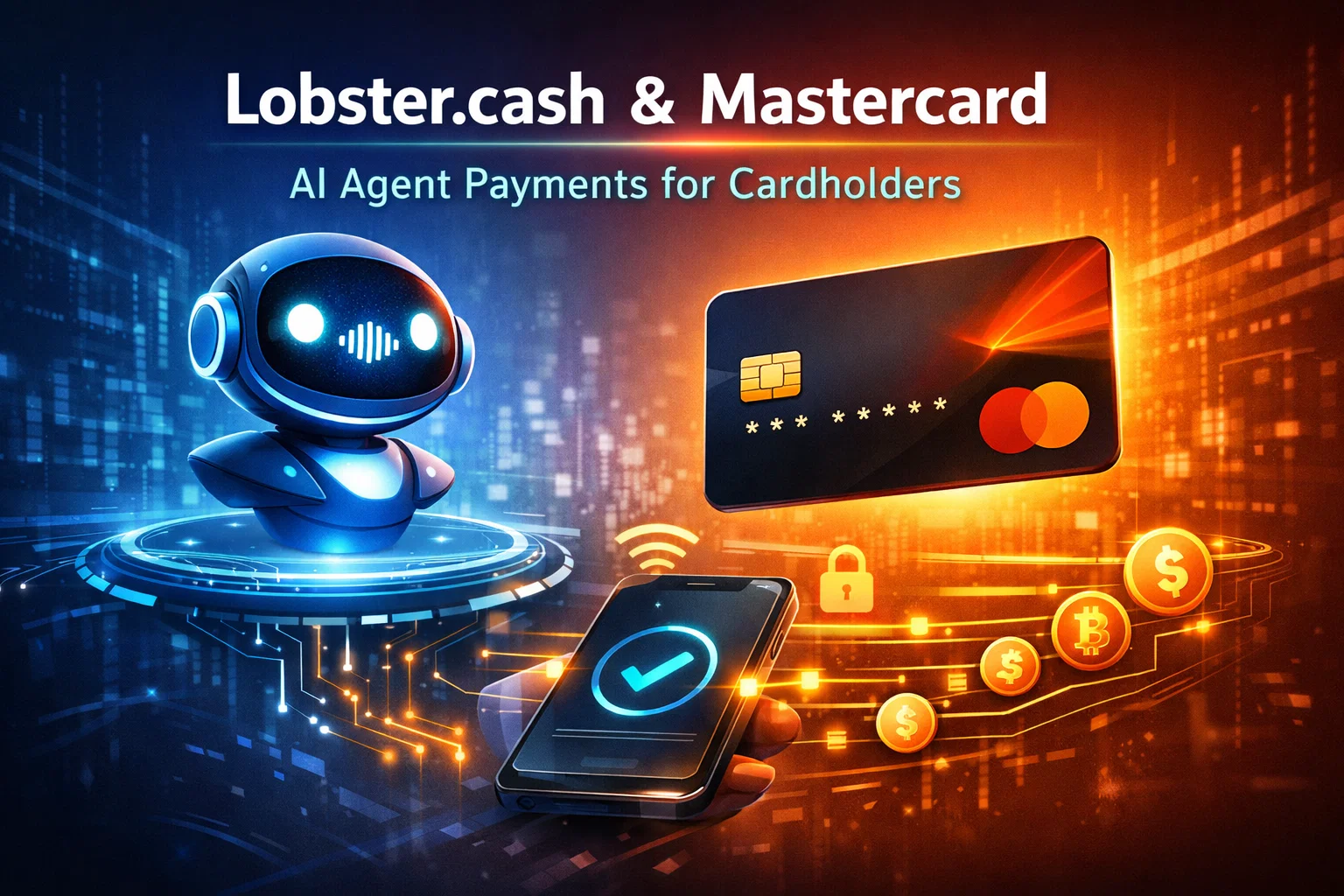
 Lobster.cash, the payment solution for AI agents built by Crossmint, has announced plans to integrate Mastercard Agent Pay and Verifiable Intent, enabling AI agents on open agent platforms to transact securely using consumers’ existing Mastercard cards. The integration brings together network-backed payment infrastructure and standards-based proof of authorization, extending trusted card payments into rapidly growing agent ecosystems.
Through this integration, Mastercard cardholders using OpenClaw will be able to authorize AI agents to make purchases on their behalf, with every transaction governed by issuer controls, authenticated through Mastercard’s network, and cryptographically linked to the user’s explicit intent. The solution also uses Basis Theory as the agentic credential layer. Mastercard Agent Pay will initially be available to OpenClaw agents through lobster.cash, with plans to expand to additional supported agentic platforms.
As agentic commerce grows, secure and accountable AI-enabled payments have become essential. Mastercard Agent Pay enables consumers to delegate purchasing to AI agents without sharing sensitive credentials, while preserving issuers’ oversight, network controls, and traceability. It supports scalable agent-driven commerce, giving issuers insight into agent activity and enabling developers to innovate safely.
Lobster.cash provides payment infrastructure built for AI agents across leading platforms including OpenClaw, Claude Code, Devin, Hermes, and Zo Computer. OpenClaw alone has become one of the fastest-growing open-source projects in history, with over one million agents deployed across more than 20 messaging platforms. Lobster.cash provides a secure, easily accessible payment standard that gives agent users programmatic control over what their agent can spend, where, when, and with which payment method. As open agent ecosystems like OpenClaw scale rapidly, this integration introduces network‑backed trust, accountability, and issuer-aligned controls into environments that have historically relied on platform‑specific or developer‑defined controls.
“Mastercard Agent Pay is one of the most trusted payment infrastructures designed for agentic commerce in the world. Bringing it to lobster.cash means agent users don’t need a new wallet or a new card,” says Alfonso Gómez-Jordana Mañas, Co-Founder of Crossmint. “They can put the card they already have to work for their agent, with the security and control they expect from Mastercard. This is how agentic payments reach everyone.”
Securing Agent Card Payments With Verifiable Intent
Equally critical to agentic commerce is the ability to prove who authorized an agent, under what conditions, and within what limits. To address this need, all agent‑initiated transactions processed through lobster.cash using Mastercard Agent Pay will leverage Mastercard’s Verifiable Intent framework.
Verifiable Intent is a standards‑based trust layer, co‑developed by Mastercard with Google and aligned with the Agent Payments Protocol (AP2) and Universal Commerce Protocol (UCP). It produces cryptographic, tamper‑resistant records of user authorization, enabling issuers, merchants, and platforms to independently verify that each transaction occurred within the scope a user explicitly approved. Designed to be protocol‑agnostic, Verifiable Intent serves as a shared source of truth across open agent ecosystems.
Together, Mastercard Agent Pay and Verifiable Intent ensure that delegation to AI agents does not come at the expense of security, transparency, or consumer protection—embedding trust directly into the transaction lifecycle.
Mastercard Agent Pay has already been implemented by leading financial institutions worldwide, including Santander, Commonwealth Bank of Australia, DBS, and UOB. The integration with lobster.cash extends this trusted infrastructure to open, developer-led agent ecosystems, without compromising issuer oversight or consumer protections.